Spotify
 Goodpods
 Apple Podcasts
 Amazon Music
 Pandora
 RSS Feed
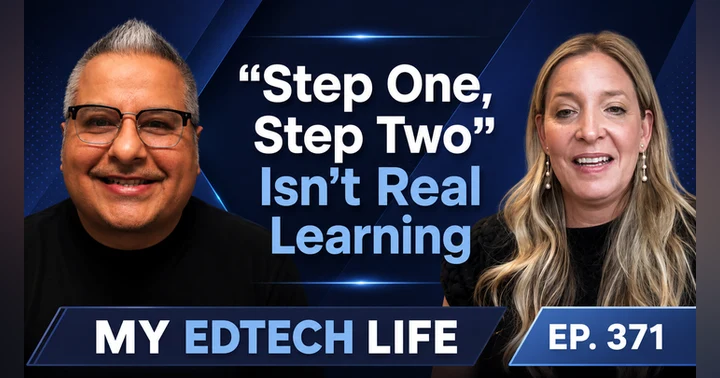
 "Step One, Step Two" Isn't Real Learning | My EdTech Life 371
"Step one, step two, step three" isn't how real learning happens. On this episode of My EdTech Life, Dr. Alfonso Mendoza sits down with Cari Orts, also known as Techie Cari, an educational technology specialist at Marble Falls ISD with over 20 years of experience in education, to discuss maker spaces, project-based learning, and why AI will never replace real teaching.
Key Takeaways
- Technology in the classroom should function like a textbook or a reference resource rather than serving as the entire learning platform.
- Hands-on project-based learning, such as Cari Orts's Cardboard Carnival, increases engagement, improves behavior, and encourages critical problem-solving.
- Teachers can save valuable planning time by bundling 10 to 15 curriculum standards into a single, comprehensive project instead of teaching them in isolation.
- Digital tools like photographing daily progress enable students to maintain a visual journal of their creative process and reflect on their learning milestones.
- AI-generated lesson plans and rubrics work best as a starting point, but educators must refine and rewrite them to ensure they remain truly measurable.
"Step one, step two, step three" isn't how real learning happens. On this episode of My EdTech Life, Dr. Alfonso Mendoza sits down with Cari Orts, also known as Techie Cari, an educational technology specialist at Marble Falls ISD with over 20 years of experience in education, to discuss maker spaces, project-based learning, and why AI will never replace real teaching.
Cari shares why she believes technology should work like a textbook, not the whole classroom. She breaks down her Cardboard Carnival project, a K-5 event that fills an entire school gym with games kids build from scratch, and explains why AI-generated rubrics fail teachers unless they are rewritten to be measurable. This episode is packed with real classroom examples for K-12 teachers, instructional coaches, and district leaders who want practical ways to bring project-based learning back into their classrooms without losing instructional time.
WHAT YOU WILL LEARN IN THIS EPISODE
What is the problem with 30-minute daily EdTech platform requirements?
Many districts require students to use a paid platform for a set amount of time each day to justify the cost. Cari explains why this turns into compliance instead of real learning.
Why does Cari Orts say step-by-step instructions hurt critical thinking?
Scripted instructions teach students to copy steps rather than understand why something works. Cari explains why giving students an end goal instead of a script leads to deeper learning.
How can teachers actually find time for project-based learning?
Cari shares her method of bundling 10 to 15 standards into a single project instead of teaching them one at a time, which saves time later in the school year.
Why are AI-generated rubrics not accurate for grading?
AI can create a rubric quickly, but Cari explains why it is not measurable until a teacher rewrites it with specific, gradable criteria.
What is the Cardboard Carnival project?
A K-5 maker space project inspired by Caine's Arcade where students build carnival games from cardboard, then host a school-wide family math night to showcase them.
How should teachers use AI in the classroom?
Cari recommends writing content first, then using AI only to refine it, rather than generating lessons or newsletters from scratch.
TIMESTAMPS
00:00 Intro and welcome
00:01:00 Meet Cari Orts, also known as Techie Cari
00:03:00 The problem with 30-minute daily EdTech compliance
00:04:00 How COVID changed hands-on learning in the classroom
00:08:00 What other districts and states are seeing right now
00:12:00 The shoe building project and low tech, high engagement learning
00:15:00 Why step-by-step instructions are not real learning
00:19:00 The Cardboard Carnival project explained
00:26:00 How to find time for project-based learning
00:28:00 Why AI-generated rubrics are not measurable
00:34:00 Bringing parents into student learning
00:35:00 What teachers get wrong after a conference or PD
00:38:00 Designing PD for speedboats, tugboats, and anchors
00:43:00 Cari's honest take on AI in education
00:46:00 Is AI literacy a realistic goal for teachers?
00:51:00 Speed round: edu kryptonite, billboard idea, and trading places with a student
00:55:00 Connect with Cari Orts
ABOUT THE GUEST
Cari Orts, known as Techie Cari, has over 20 years of experience in education as a teacher, GT specialist, and maker space lead. She currently works as an educational technology specialist at Marble Falls ISD and presents nationally on AI, project-based learning, and hands-on instruction.
Connect with Cari Orts
Facebook, X, TikTok: @TechieCari
LinkedIn: https://www.linkedin.com/in/cari-orts-740ab6a1/
CONNECT WITH MY EDTECH LIFE
Website: myedtech.life
More episodes on project-based learning, maker spaces, and AI in education available at myedtech.life
Thank you to our sponsors: Comeback Coffee, Book Creator (use code MyEdTechLife for a free 3-month premium upgrade)
Contribute to the show: Buy us a coffee!
Become a show sponsor: email myedtechlife@gmail.com
Thank you for watching or listening to our show!
Until Next Time, Stay Techie!
-Fonz
🎙️ Love our content? Sponsor MyEdTechLife Podcast and connect with our passionate edtech audience! Reach out to me at myedtechlife@gmail.com. ✨
Frequently Asked Questions
Who is Cari Orts on My EdTech Life?
Cari Orts, also known as Techie Cari, is an educational technology specialist at Marble Falls ISD with over 20 years of experience in education, known for her expertise in maker spaces and project-based learning.
What is the Cardboard Carnival project?
The Cardboard Carnival is a K-5 maker space project where students build functional arcade games out of cardboard and host a school-wide family math night to showcase their designs.
How can teachers find time for project-based learning?
Teachers can save time and cover multiple educational standards by bundling 10 to 15 different TEKS or state standards into a single, cohesive hands-on project.
How should teachers use AI in the classroom?
Teachers should use AI as a drafting tool to generate initial ideas, project outlines, or rubrics, and then edit and customize the content to fit their specific student needs.
00:00 - Welcome Sponsors And Why It Matters
01:03 - Meet Techie Carrie And Her Work
02:58 - The Screen Time Backlash After COVID
08:25 - AI For Teachers Not As A Crutch
12:03 - Building Shoes Plus Digital Journaling
19:33 - Cardboard Carnival That Pulls Families In
26:41 - PBL Without Losing Time To Testing
34:30 - What Goes Wrong With Conference Tools
37:55 - Challenge Based PD For Every Teacher
43:06 - Realistic AI Literacy And Best Practices
51:10 - Speed Round Time Billboards And Empathy
55:01 - Where To Connect With Techie Carrie
56:39 - Final Thanks Sponsors And Sign Off
Welcome Sponsors And Why It Matters
Dr. Alfonso Mendoza
Hello everybody and welcome to another great episode of My Ed Tech Life. Thank you so much for joining us on this wonderful day. And as always, wherever it is that you're joining us from around the world, thank you so much for all of your support. We appreciate all the likes, the shares, the follows. Thank you so much for engaging with our content. And a big shout out to our amazing sponsors that help make this show possible so we can continue to bring you some amazing conversations week in and week out. So I want to give a big shout out to Come Back Coffee. Thank you so much for keeping us caffeinated and highly creative. As always, want to thank Book Creator and make sure you use code My EdTechLife for a free upgrade to the premium version for three months. So you can check that out. Thank you so much to Eduate and Peelback Education as well. And
Meet Techie Carrie And Her Work
Dr. Alfonso Mendoza
again, thank you, thank you to everybody for engaging with our content. And as always, I am excited to be here because every conversation is a wonderful conversation where not only I get to learn because it's my personal PD for 45 minutes, but I get to share that with you all. And uh so I'm really excited to bring back a now this is gonna be a two-time guest, but it's somebody that I've known for a very long time, and it's great that we've always remained connected at some point, shape, and form. We always kind of cross paths again. So I would love to welcome to the show the always amazing and wonderful Carrie Ortz. Carrie, how are you doing today?
Cari Orts
Good. I think it's been 10 years that we've known each other. I was thinking about this very.
Dr. Alfonso Mendoza
Actually, I remember when you first came down to our district and did like the Google uh training and everything, and then of course, running into each other at conferences and or just even keeping in touch on social media. So it's just been great to stay connected with you, my friend, and see all the great things that you're doing. But for our audience members that are listening and maybe may not be connected with you yet or a little familiar with you, can you give us a little brief introduction and what your context is in the education space?
Cari Orts
Excellent. So I've been in education for over 20 years. Um, I have been a teacher, I've done elementary education, then middle school teaching. Um, and then most recently in the past six years, I have been a GT specialist and a makerspace captain. And I made up that title for captain because I'm just leading the charge. I'm not, you know, doing everything. And then um, but right now I'm officially an educational technology specialist at Marble Falls ISD. And um, you know, my passion really is for kids to take the lead on learning and to be involved in their learning as much as possible. So that's kind of me. And I'm I'm otherwise known as techie carry to all my friends and co-workers. So if they need it something, it's always like, I need the techie carry
The Screen Time Backlash After COVID
Cari Orts
right now. I'm like, I got you.
Dr. Alfonso Mendoza
I love it. And techie carry is something that I have definitely heard for many years and obviously on social media, but also the flamingo, you know, and that's a big, that's a big thing there. And uh so you'll learn a little bit more about that too later on. But Carrie, I thank you so much for this invite and that we connected again because this is this conversation is uh I think very pertinent for what at least I'm seeing, what I'm hearing, and obviously with what we're hearing is so much about the the tech backlash that we hear and you know, minimizing screen time and all that great stuff. But at the same time, um as I speak with school districts, like I talked to you a little bit pre-chat, is I'm hearing that they really want to take that step in making the learning a little bit more visual or a lot more visual, where now students are either speaking, they're demonstrating, they're doing videos and so on, as opposed to maybe what they were kind of getting, which is a lot of times the platforms where students will have to sit 30 minutes per day per subject as part of a kind of like either supplement or I I call it compliance basically because it's like, hey, we're paying millions of dollars now. We got to get the minimum usage on this to think that we're gonna grow. So I want to ask you, Carrie, in your experience, and and we can go back to when we first met each other and or in your years of education, what has that, what has what shifts I should say, have you seen from the very hands-on and maybe to more screen time and now coming back to more of a mix between hands-on and using the tech? Because I know that you work with students that sh do some wonderful uh projects and not only classroom, but you take this school-wide. So tell us a little bit about some of the those shifts in your experience and what it is that you're seeing now.
Cari Orts
So, you know, obviously COVID, you know, made a huge shift into kids just being on the screens constantly. You know, that's their learning system. Um, and and like the hands-on kind of went away completely. And that was really sad, but like that's how we survived, unfortunately. And um, and now, you know, as we've kind of progressed away from COVID, I'm getting kids saying, Hey, um, can I do this on paper instead of on a Google slide? And I'm like, sure, you know, whatever you need to do, kind of thing. And I think the kids are kind of tired of it at this point as well. I think they're ready to make that transition. And so I've slowly started to like integrate ways for my kids to practice their handwriting again and like sneaky ways and ways for then to kind of be more hands-on. Um, but the biggest place that I've seen that big transition from, you know, super techie to not so super techie is in the makerspace. Um, and you know, I I could talk on and on about it, but you know, you see kids that normally have behavior problems, they come to the maker space, perfect. Um, you see low-achieving kiddos come to the maker state space and start building, perfect. Um, and so that's really been my big area of like, you know, kind of analyzing the tech versus the no tech. And um it's just a magical place and and it's kind of hard to describe unless you're inside of it and doing it with the kids. But um, I was thinking about this before we jumped on today. And I think the, you know, technology has kind of turned into that textbook now. It's something the kids reference when they need that extra little boost or they need to look at something, and then that Chromebook is closed and they're going for it. So I'm very happy to see this transition. I think it's wonderful. Um, I think technology should be used as a resource, not as the whole learning platform. And so um, I'm excited to see what's going to happen in the future.
Dr. Alfonso Mendoza
Yeah, absolutely. You know, and those are conversations that are so good to have and to hear from experienced people such as yourself that are making those moves or have that firsthand anecdotal evidence of seeing how students are thriving when given the opportunity to share their learning, not necessarily on a screen, but on paper or with something physical, tactile, but still, you know, having the opportunity to include some of that tech, whether you're recording yourself, giving an explanation, which I think is something that is so valuable. And but like you said, where the tech is not front and center and the star of the classroom, but it should be that kind of almost invisible tool that's a supplement to the learning and the sparking of curiosity and to doing the research and digging in deeper. So I know that right now with the conversations as far as districts and you know, just nationwide minimizing screen time, it's like they lump in all ed tech together, you know. And I I think that that to me, I'm thinking, well, wait a minute. Like right now you mentioned, you know, your students at, oh, maybe low achieving students or behavioral students, but what about those students like multilingual learning students? What about students that are in special education that need additional supports? Are we just gonna unplug everything and just say nope, figure it out some way, some shape or some form? So, and I know that you also do some work with uh the Bureau of Education. So maybe do you mind sharing maybe in your experiences, if you have been working or alongside them or gone to some trainings, what is it that you hear from other places, other states, or different perspectives
AI For Teachers Not As A Crutch
Dr. Alfonso Mendoza
about this?
Cari Orts
Um, I think most of the schools that I speak to and present to, you know, through the Bureau, they're they're kind of in the same boat as us. They're they're tired of the devices, they're tired of that being, you know, just the main focus and they want more hands-on. You know, I do a presentation with BER and we talk about using AI. And I focus a lot on like um creating PBLs with AI, um, creating alternative assignments with AI, and then pushing them out to students so that, you know, it's kind of a time saver. Because I think that's one of the biggest things when it comes to education is time. And so my focus in AI is creation for the teachers. Like, you know, you have these ideas in your head, but you just can't get them out quick enough for your kiddos. So um, my focus is creating PBLs, creating um, like you said, assignments that fit the kiddos, individualized assignments, and then pushing those out, you know, in a paper format or like I said, PBLs and so forth, um, you know, hands-on centers and stuff like that. Um, so I think it is a big thing, um, is is kind of shifting in different states because, you know, we're just in Texas, you know, but different states are definitely making that shift as well. And I love to see it. So um, you know, our our kids are always gonna have devices, they're gonna be using them, you know, through college, through adulthood. But I think we need to teach them that like it's not our sole learning platform.
Dr. Alfonso Mendoza
Exactly. Yeah, and you know, and that's something like I think like you mentioned and that we can contribute to what happened in 2020. I mean, with everything shut down and everything was in front of the screen. And, you know, in my experience within my district, when we kind of slowly started coming back to brick and mortar, I noticed that, yeah, the devices were like put away, like teachers didn't want to use those because you know, it's just kind of like uh that experience was not very fun for a lot of them. And then after that, it's well, we need to supplement the learning, we need to supplement math, we need to supplement reading, and then come the platforms of, well, they gotta be on the platform for at least 30 minutes per day or 30 minutes per day per week for every subject and so on, where now it becomes that repetitious kind of fancy flashcard, you're just going through it just to to do the time. And and for a lot of students, I feel that that is definitely not a great way to learn, you know, because it's a supplement, not your main lesson. And and you know, I'm not saying that all teachers, but there would be some teachers that'll say, Well, I'm just gonna front load all of this, and there you go, kids come in, and all right, that's your 90-minute period that you had, and you just sat on the computer just doing these problems. And what are the students actually getting from it other than learning multiple choice or just gaming the the system in that sense and not being hands-on? So my thoughts right now have been teachers are are experts in those domains that they teach, and they're giving the information, but then the students are so bloated with that information, there's no outlet for them to share that knowledge and learning with hands-on approach, discourse, discussion, and a blend of creative tools. Now, since I want to kind of, you know, uh get into your experience as a GT teacher also as well, because I have seen what you have done not only with, you know, Kinder, but Kinder through six, making a whole project at the the whole uh school level. So I want to ask you, what did you see and what was the experience for those students when they didn't
Building Shoes Plus Digital Journaling
Dr. Alfonso Mendoza
have to use the device the whole time? Or maybe there was a blend of because they would need to do some research to do their builds. So I want to hear your experience so our audience can hear that experience and say, hey, this is something that can be done with low tech.
Cari Orts
So my favorite project is my fifth graders. Um, they build a pair of shoes from scratch. Um, and so, you know, we start it by researching, and I'm like, just research crazy shoes, you know, and they find, you know, the aquarium shoes, they find, you know, just they just find these wild shoes. And then um, you know, we study like, you know, the shoemaking process just very, very, very briefly. Because I want them to go in like with just this much knowledge, just enough knowledge to feel confident to get started. And then um they'll close those Chromebooks. We're working, we're building. And then this is where I think technology is really a great thing. We would take pictures at the end of every class period just because it was a time for us to go, this is what I did today. Because I think a lot of times our kiddos forget they started over here and went all the way over here in one class period or one day, whatever it may be. So it's hard for kids to reflect and say, I did accomplish something today. So I think that's where technology is really great because we can take pictures, we can take quick videos, um, they could just do a quick little reflection and then they can come back to it in several days and be like, oh, I was, you know, it my share looked really ugly today, and then three days later it would look magical. So I think that's where that that little technology is an enhancement to our world because we can, we can journal, we're digitally journaling. Is that a word? We're gonna say it is um what we're doing in our progress. And then we can actually use that to go back and problem solve as well. So um, you know, my kiddos, they had to make two shoes. Well, they would make one, and then it would come time to make the second one, and they'd be like, I don't remember what I did. And so that digital journaling make gave them that ability to go back and look and they're like, oh yeah, I did that next, and then I did that next. Um, so this the technology kind of turned into more of a way to to show their process and to remember their process. And then at the end, you know, we made some cool commercials um and so forth. Because I went to a conference, you know, how many years ago? And the person said, our kids live in a society where they want to share and they want people to see what they're sharing, and they want people to validate that they saw it. So making these commercials and giving the other kids rights to comments or provide feedback and so forth hit all of those little things because our kids all watch YouTube. That's how they learn things now. And you know, with that validation, oh, we liked it, we subscribed, whatever it may be. So I like to find a way to kind of put that in my classroom where the kids are seeing each other's, they're validating that they saw it, and then they're leaving some kind of positive feedback.
Dr. Alfonso Mendoza
Oh, I love that.
Cari Orts
That that's how I kind of like technology in my room. And um, you know, and there's so much problem solving that goes on in my classroom that you can't you can't really like show it in a way. Um, but I think that the kind of taking the hands-off approach to tech technology allows more problem solving to happen. Um, because the kids aren't immediately, you know, I think what happens so many times, and it's really annoying to me, is that someone says, okay, step one, step two, step three, step four, follow these exact steps. That's not how real learning happens, let's be honest. Um, kids need to know, okay, here's my end goal. And then I don't care what pathway you take to get to it, this is if you get to this end goal, great. Because that's life. I mean, your pathway through to your current position is probably totally different to than my pathway. And that's okay, you know? And we all have different strengths and weaknesses, and I think our kids need to embrace that. Like my path may be like this to get there, and some other kids' path may be like this to get there. Um, and I think that's just that's just how it it needs to be um in education is like here's our end goal. I hope you get there. I'm gonna support you to get there. You're gonna make mistakes, you're gonna fail three times, and here's the support you need to get there.
Dr. Alfonso Mendoza
Yes. No, I love that. You know, everything that you said there just takes me back to my classroom experience. And, you know, one thing that I love that you mentioned is right now, towards the end, that you talked about how we as teachers oftentimes it's the way that we teach, it's like here's like you mentioned, step one, step two, step three. Then really what happens, you know, and myself being a former math teacher, you know, in algebra, it's like, okay, you know, we're talking about algebraic linear equations. So here are the steps to solve. But it didn't take me a while because uh, you know, I didn't come through the traditional, you know, education route, learning a lot of pedagogy. I learned pedagogy while I was working and understanding that. But I taught it the way that I learned it. But then the students, I didn't realize that, you know, students are just mimicking what I'm doing. There isn't any kind of like, hey, let's take this a step further, in depth, spark that curiosity, like, why does this line look this way? Or why is this the you know, the slope changing? How does this affect velocity? How does this affect this? And start asking those questions where maybe you would ask those questions, but it's just real at a at a just very superficial level. But one thing that I love that you mentioned is okay, you know, here is the lesson. This is what we're gonna go through. And with this little bit that I taught you, now we're gonna go ahead and figure out this problem and then have the students, you know, go and research, do the learning, partner up, have those discussions. And when I started doing that, then I found that there was greater success in the sense that the students actually understood the concept and knew what was happening, the inner workings of that equation, where now it's really, hey, here's tier one. I already did my stuff on the board. Okay, go. And all the students will do is mimic. Now, I I just want to do, I want to add that it that doesn't is not just for you know, K-12, but I and I've mentioned it many times, even going through my master's program or doctoral program, where uh a professor said, Hey, you know what? This year, this semester we're gonna do something different. I'm gonna give you all a choice board. And the look on my peers' faces, where these are directors, ex you know, some of them are assistant superintendents, APs, and the dear in the headlights look like, like, what do you mean? Like, I don't get it. I don't understand. What do you mean, a choice board? It's uh it's always like just give me the exemplar, what you want as your final product, and just I'm gonna mimic that because I just want my grade or my A. And it's something that we do from such a young age to our students that later on, like you mentioned, it's that critical thinking is like, like, like, what? Like this, this blows my mind. This isn't you're supposed to tell me exactly what to do, not give me a choice of how I do it. Man, I I was like a fish in water there because I was like, oh, okay, this is fantastic. And I I always tell the story. I I told my my professor, I was like, hey, there isn't a podcast here, but can I do a podcast? She's like, Yeah, go ahead, do it. I was like, All right, I'm set, I'm ready to go. Because you learn how to, you know, uh adjust, you amplify, you oh I mean, excuse me, you overcome
Cardboard Carnival That Pulls Families In
Dr. Alfonso Mendoza
those barriers because those are what critical thinking skills you want. So uh I also want to ask you about one of your projects too, because I I want my audience to hear your experience of also being able to do this at a bigger scale. So I think it was the the zoo project. Is that the one that that yeah? So can you tell us a little bit about that, the idea that sparked it and what you saw not only from students but from the community? And what I mean by community is parents too getting involved because this is something that could be very great for my audience to be able to listen to and hear.
Cari Orts
Can I actually share about our cardboard carnival?
Dr. Alfonso Mendoza
Oh, okay, yeah, go ahead.
Cari Orts
It it's it's like the one that I've done consecutively. Um, and it's it's probably the one that like has brought the community together the very, very most. So what we do every year is we have a cardboard carnival based off of Kane's arcade. You've probably seen it. It's a pretty, it's pretty old video. But um, once again, this kiddos are introduced to some pictures. Um, I give them a couple of websites of different um a different cardboard carnival games, like the little, because we start this in Kinder, so it's a Kinder through fifth grade project. So Kinder obviously is gonna have little easier is easier things. And then fourth and fifth grade, they've done it with me several years. And I say it's cardboard carnival, they go, no, you don't need to tell us anything, sorts, we got it, you know. And so we have spent about half a day. Um, and we do it during our specials rotation, so it's about 55 minutes. So we spend about half of that time, one class period, researching, figuring out um our groups, figuring out what game we want to make and so forth. We we sketch it and then we start building. And so um, you know, the kids all have um they have a they have a list of about six, six things that they have to have on their game. So that way they have a targeted outcome. So it's just a simple little checklist. Every time we go through, we check and we check in, you know, all that good stuff. And then we have what's called a family math night. And so part of their game is how many tries do you get to do it? How many points do you get for scoring a basket or whatever it may be on their game? Um, and then the parents come up, we fill our entire gym with all of these games that the kids have created. Um, and it's pretty magical. I will have like grown men sitting on the floor playing these games with their kiddos. Um, I had a family where the middle school siblings Came, the grandparents came, the parents came, everybody came to play these games. Um, as you can imagine, there's like bouncy balls and everything rolling all over the gym and everything. Um, and then I make a game too that I end up raffling off and everything. But the the main components of our cardboard carnival is first group work, which as you can imagine can be very difficult because one person may want to run with an idea, but we have to work in a group. We talk about a lot of science, engineering, we do a lot of problem solving, we talk about naming our games. Um, and we usually pick a theme that goes with the theme of the whole school for the year. Um, and then um there's also math. So, like, like I said, if you score this, you score, say they make a basketball game. We score, you know, twice how many points do you get and all that good stuff. But um, and then there's a deadline, like the first day introduced it, this is our deadline, and we have this many class periods to finish it, and so forth. So it has really turned into one of the favorite things that we do. Um, I think our district said that's like one of the most highly attended elementary um events of the year. And so um, it's something that like, you know, hopefully they'll continue doing now that I've transitioned to a different position in the district. But um it's magical. And and the cool thing about it is, you know, I give those six expectations at the very beginning. And what I have noticed probably 95% of the time with my projects in the makerspace is, you know, I give the minimum that I want and they just blow it out of the water. They keep adding more and more things. It gets more and more intricate. Um, you know, that that's the time where they're researching different things on their Chromebooks that they could add to it. They're picking a theme and then they're looking up themes. Um, one year we did um Animals in a jungle, or it was a jungle theme, and they're literally like, we finished the basic construction, we're gonna go research different animals that would be in this habitat, and they drew them perfectly, you know. And so um, that's the cool thing is that the kids always go above and beyond. And that's what I think as an educator, we always hope that yes, our kids are meeting all their goals, but they're so excited about it and so engaged that they're just gonna like keep going beyond. So it's my very, very favorite event. Um and it is really cool to cool for the parents to come in, they look forward to it. Um and it just, it just it makes you go, oh, this is what learning is about. So I love that.
Dr. Alfonso Mendoza
You know, it's so many things and so many components there, you know, and especially what I love that I'm hearing too is just those skills that students can get and use at such a young age, which is like you said, the critical thinking. They have to communicate, they're doing the research, they're collaborating, you know, and those skills will take you much further than you think, you know, and obviously right now the focus is well, everybody's gotta learn how to do AI and everybody's gotta learn how to, you know, prompt and do those things. And I'm thinking, well, yes, there there's a time and a place for that. But at an early age, K through 12, I mean, hands-on problem solving. R to me, that's why Rhesus is so important too, because I mean, once they're out there, they are running around, something happens, somebody trips or whatever, or maybe there's, you know, a little bit of a I won't say like, you know, kids not getting along, but that's where they learn how to problem solve and you know, you know, just collaborate with one another and hang out and talk and do that. And and that's such an integral part too. But now it's like, nope, no more recess, none of this, none of that. But anyway, that could be that'll be a whole other point. But Gary, I want to ask you too, because I know that you're very passionate about project-based learning, and this is something that is near and dear to me too. In my last years within the classroom before I moved into uh the district level role, I was huge on everything was a project. It's let me show you the little that we're gonna cover, and now you're gonna create, very similar to what you're talking about. But I want to ask you because uh, you know, your experience and maybe giving some teachers some advice because I I am hearing a lot of uh now because of generative AI and and the fear of just copying and pasting and cognitive offloading and so on, a lot of talk of, well, you know, I want to do more projects, you know, some project-based learning where students can show their authentic learning, but we know that curriculums, we know that tests, you know, eat up a lot of that time and the cadence is like fast
PBL Without Losing Time To Testing
Dr. Alfonso Mendoza
for the year. What might be some great advice for some educators that are listening right now that would love to implement a little bit more of this project-based learning, but are just hesitant because, well, I have time for that. Can you is there anything that you can share that kind of give them some peace and ease of mind that this is something that could still be done?
Cari Orts
So the cool thing about PBLs is you can like stack 10 to 15 different teaks in one project. And I think that's the biggest thing. And I tell my teachers and myself, you know, if you're going to make a PBL, it has to have teaks. You start with the teaks. You don't start with like flamingos because I love flamingos. It's teaks-based, okay? Period. Like you have to start there, and then you can find a way to bring in your fun stuff, you know. Um, so I would just find a way, and there's so many like great AI places where you can put in different teaks and they will make a PBL that fits it. Um, or you could just tell it something you're thinking and then throw in the teaks and it will make it for you. You can always tweak it. Um, I kind of tell teachers like if you want to do a PBL and you're using AI, AI is a great starting point. And then you go in and you tweak it to fit your needs. Um, a great example is that we were um building a new playground at our at our one of our schools. And so I was like, oh, I have to have some kind of PBL like for my students in my makerspace. And so guess what? You know, a playground has lots of 2D and 3D shapes. Okay, so there's math right there. Um, and then we added some other things and so forth, but lots of teaks involved. I think you needed to relate it to the kids' world. Um, you mentioned the zoos. Um, we created zoos before based on animals based in Texas. We've created restaurants based on what our community needs and so forth. Tons and tons of teaks, but so you gotta relate it to the kids though, because that's how you're gonna get your buy-in. If the kids are excited about it, they're gonna have more buy-in. And then very most important thing is a rubric. And you give that rubric before you start the project. And I'm saying that because that is it's the opposite has happened. And the big thing about rubrics is it has to be measurable. You can't say this is good, this is okay, this is bad. It needs to be they did 10 out of 10, they created 10 out of 10 blank here. They did, you know, it has to be measurable. And what I have found with AI rubrics, they are not measurable, they are a great starting point. And then I have to go in and say, okay, they created 10 out of 10 3D shapes, they created 7 out of 10 and so forth. So I think that's what has it is makes teachers hesitant to do PBL because they don't know how to grade them. So you could literally break down your rubric by each teak that you're teaching and make it measurable. Because then there is none of that back and forth. I don't know, um, and so forth. Make it measurable.
Dr. Alfonso Mendoza
Love it. Love it. Great advice. And you know what? Like I at that moment when you said that, like I felt so excited because, you know, in the classroom, again, and I'm working with fifth graders and I'm doing math, science, social studies, and we would do projects, but I you hit the nail on the head there where it's like it's not one project per teak, it's bundle your teaks. And when you do that, you know, that is gonna help you in the long run because when you do get to that section that is ahead, the students have already had that experience. And then you can go right through that lesson and they have a better understanding. And now they start making those connections. So that's why at the very beginning of the year, like you mentioned, it's I would have my expectations. Here's what we're gonna do. These are our projects, but very clear that you mentioned, I love that that you were clear about it, having something that is uh the your rubric that is measurable. And I would even go and do like a progress uh kind of check for students, also as well, just so they can kind of see and they can get that constant feedback. But I think it honestly, my colleagues thought that, man, you're out of your mind, like you're doing way more work. But at the end, I was able to finish and my curriculum in time because I was bundling Teks and the students were seeing all of those concepts all built into the project that they were working on. That when we got to the point of, hey, it's time to review for your state assessments and things like that, they're like, We got this, like this is easy, like we've already gone through this. Or they'll say, Sir, like, can I create uh a tutorial for star using uh scratch, you know? And I was like, Okay. And then they would get on the Chromebook and then they would create their own little water cycle, and then one will create uh the planets, one would create, you know, all this other stuff, and then they created their own stations on a Chromebook and they would stand right in front and they did it to where they can cue it, and then the little definition will drop. I'm like, this is amazing, you know? And and that's again adding a little bit of that tech. But although it does seem ominous, I I think the that was great advice that you shared. Bundle your standards, and that will take you a long way and help you be more efficient when you do cover those subject areas. So I love that. Great, great advice.
Cari Orts
That um I had a lot of success with. I just went through my national board certification and I got that knocked out. But one of the things that I that I included in my national board was having the kids self-evaluate themselves with the rubric. And so that was really eye-opening to my GT kiddos because, you know, they had seen the rubric, you know, for a month or longer. They they knew what they were doing, and like you said, the progress monitoring, they're checking in on themselves. Um, and so what I did was parents came for their final presentations and I gave the parent and the child the rubric to go over together. And it was, it was really, it was, it was interesting for me to step back and watch because the mom would be like, oh no, you you only had so and so. So that because the kids all wanted to give themselves the highest mark. And they would start counting. And so it worked into it worked in in a really great way because the parents were able to see all the stuff that they had done for their PBLs, because often they're like, I don't even know what they're doing in GT. Well, this rubric showed exactly what they had been doing into the into like how high, you know, they were going with things. And then the kids were able to reflect and be like, you know, I was kind of lazy on that one section and I didn't really get as high a score as I wanted it. Um, so it it turned out to be this really great, like, you know, you some of the kids were like, oh yeah, I nailed it, I knew I did. And then some kids were like, hey, next to him, will you help remind me that I need to type my sentences a little bit better and and add some more detail on the typing part? And I was like, oh sure. But I felt like that was a really great way to kind of wrap up every PBL was the kids' self-reflection of their rubric with the parents, um, because it kind of brought it full circle.
Dr. Alfonso Mendoza
I love that. You know, and that's something that is great because the parents are involved. And and I just want to add this because too, I've been a huge advocate for, you know, learning community. It's like you need to include parents. The more you include parents, the more support that you'll get, the more that they see, you know, their their kids doing some great stuff and learning these skills. I mean, it's something that is amazing. That's something that's shared. So that's why I loved, you know, the the the use of technology, like you mentioned, to document the process, the growth. And it's a digital art digital learning artifact that when my parents would come into open house, all the other teachers had the folders with, oh, here's this paper I got a hundred on, here's this, and explain it to me, like what is it, or they just looking at grades. Well, I had Chromebooks all on their desk. So it's like, hey, I want you to sign in. I want you to show your parents your
What Goes Wrong With Conference Tools
Dr. Alfonso Mendoza
portfolio, show them what you created, your slideshow. And then the parents are like, My kid did this. I was like, absolutely. And they're explaining to them, oh, this is what I learned, and this is what, and it it it goes in deeper, and that's something that is amazing. So I love that, you know, for sure. Now, Carrie, I want to talk to you a little bit more on kind of uh on on the professional development side of things, because I know not only have you served as per, you know, giving doing professional development within your district, but also at conferences, but you also work with other teachers, you visit other districts. So I want to ask you, you know, as you train educators, not only here in Texas, but just nationally, what are some of the things that teachers might be getting wrong when they go to a conference or maybe they go to a professional development and they bring back that shiny new tool into the classroom after a PD session?
Cari Orts
Oh man. I think they think it's gonna replace I don't know. It's hard to oh, it's a great question. Um I think, you know, we go to conferences, we get excited, we see something, and then um we might use it for like a couple of days and then it kind of like goes to the wayside. Um or you know, the d the dreadit pre-trial and then you start to love something and then your district doesn't have the funds to pay for it or whatever. That's why, like when I, you know, am presenting at a conference, I'm always gonna show real examples from a classroom. And so that way it's attainable to the teachers. And I think that's another thing, you know. You can show me something that's really cool, but like if you haven't ever tried it with kids, then I'm not sure if I'm gonna be able to actually buy in and use it. So I think that's that's one of the things is, you know, it's gotta be something that's affordable that the teachers can use. I think providing real life examples. Um, you know, in my trainings, I have all kinds of kid examples and I show them because I want that buy-in. I want them to know that I've actually done this with kids and it is possible. And I don't know, and then of course, you know, I mentioned it earlier, it's time. You like you can show me a cool program, but if it's gonna take a ton of time for me to front load it um and manage it and so forth, I just don't want to do it, you know? So um, I don't know. Did that answer your question?
Dr. Alfonso Mendoza
Yeah, yeah, well, yeah, kind of in a way, because you're right. I think that first part really hit where it's you bring back that novel idea, you want to introduce it, and then all of a sudden it's like, okay, what happens when it loses its novelty? And you know, Carrie, I want to say that that's something that I have noticed a lot lately too, where people get excited. I know ISTE's coming up, and it's like, all right, we're gonna come back to the classrooms and then all of a sudden bombard, or TCEA, and it's like, all right, we're gonna go ahead and do it, but then all of a sudden it's like those apps or that trial or whatever just kind of goes into that tech graveyard where it's like, well, like I'm already done, or I don't have time for this, or maybe it didn't work the way it did. And I think it's just that that newness and that shiny new button that's there that you think that you you mentioned, not maybe replace a task or replace something that's gonna make things a lot easier, but in reality, it's
Challenge Based PD For Every Teacher
Dr. Alfonso Mendoza
just adding a little bit more work. So, you know, those are some of those things that I see there. Now, going sticking around with professional development because professional development season is right around the corner. I mean, I know that there's still some going on right now, but usually that comes in at the beginning of the year. So for our audience members, you know, and people that might be in your position as far as, you know, instructional technology coach or, you know, leader, you know, different titles doing the same thing. Um, as far as professional development, when you're designing your professional development, how do you balance it for your audience where you may have those speed boats, those tugboats, and those anchors? Um, so what might be some great advice for somebody that is currently in this position, or maybe somebody that is new to this position that you can give?
Cari Orts
So I you've probably experienced my PDs before. Um, and I call them the challenges. So what I do is um I have challenges based on certain applications. Um, and I group people so that you're gonna put your you can put your speed boats in your tugboats or in your, what do we call them, anchors? We can put those different groups of people together because they provide each other support. And so what I do, it's probably like a list of like 10 to 15 things they have to accomplish. I set a timer, and then that's where I'm walking around. And what happens is those speed boats are sitting there like, hey, so-and-so, do the and they're, you know, they probably have never even met each other, but it turns into this collaborative environment. And I tell everybody, I said, don't worry, after the timer's up, we're gonna go over it together. So I've kind of given them that safe space. They're like, okay, if we don't finish, it's okay, we're gonna do it. Um, and so it's been cool to watch um then do the techie carry challenges because the teachers start collaborating, they start having fun. I mean, I know it's not you're not supposed to have fun at your trainings, but we do. Um, they get really competitive, which is so fun to watch because I've you know, I have these quiet teachers, I've never seen them like really, and they're like, We gotta finish first, you know, and it's like this huge thing. Um, and then after the timer goes off, if they didn't finish, it's okay. And as a as a group, I I stand up there and I'm like, oh guys, I forgot how to do this. Could you all tell me? And so people start shouting out, and so I'm checking for understanding because I'm seeing who's who's shouting out. And then and then after, you know, and I break it up into each into little sections. But most importantly, I tell all the staff members, I say, I'm not gonna be in your classroom with you every day. I said, You're poking around, you're looking at everything, you're problem solving, because this is what you're gonna do when I'm not there. I said, Yes, I am there to support you, but you may have five minutes to try to figure this out and you're gonna go, oh wait, in Carrie's training, I clicked here, clicked here, that didn't work, and then I clicked here, and then I tried it and I got it. So you're just providing some time for them to move around, click around, try things, problem solving. You're providing some kind a little bit of community because maybe they remember that that person down the hall was in that training with them and they can be like, hey, so-and-so, remember at that training, you know. Um, and then you're also providing confidence because a lot of people, when it comes to technology, they're afraid to click. Yes. And that's the first thing I tell them in any of my trainings. I said, click on whatever, you're not gonna mess anything up. Um, and just a fun side story. Um, a school district, they they borrowed some of my Google trainings one time, and um, they emailed me later and they were like, Carrie, our staff members were so competitive, they loved it so much, they didn't even want to go to lunch. And I was like, Okay, I'm good. Like, like I think that proved right there that like challenge-based learning with adults is amazing. Yes. Um, so I love that.
Dr. Alfonso Mendoza
And I think that's something that is fantastic and something that is great. You know, like you mentioned, number one, also having that evidence of you being able to use a piece of technology and share that it is something that can be done, you know, even from K through fifth, you know, or whatever experience you've had, having that evidence, but also like you mentioned here, gearing the PD for for the adults in such a way where it makes it fun. It you take some of that pressure off. Like I always tell um the teachers that I work with, I was like, guys, just get clicky with it. You're not gonna break anything. You always have the undo button, or just sign out and sign back in. Whatever. You're not gonna break anything. So just get clicky with it. Don't don't get scared, but you're absolutely right. You know, they're they're still scared of the click. But I love, like you mentioned, you know, doing PD a little different. It doesn't always have to be just the person up there at the top, just talking the whole time, and every once in a while, you know, they they stop reading their PowerPoint presentation and then ask a question or two just to get something from the audience, but make it hands-on. I mean, this is the way that they're gonna learn. And like you, I love the way that you would create those challenges uh for the educators that get so excited about it. And I think that's what it's all about something new, something refreshing,
Realistic AI Literacy And Best Practices
Dr. Alfonso Mendoza
um, and just a different way of presenting it with the same results. And I think that's fantastic. Now, kind of sticking a little bit with that because you've seen in your years a lot of experience with professional development, a lot of experience with ed tech tools. So I want to ask you at this very moment, just what your thoughts are just on AI in education. So, do you feel like that this is what where does this land for you? Is AI in education right now something that is different? Or is it something that you may feel might just fall into that same cycle of what we see like educational technology tools kind of fall into?
Cari Orts
Um I think it's a tool. It's not an end all. Um, and I and I think a lot of people think like, oh, it's flawless, it's perfect. It's not. Um, so I think it's a great, and I say this in my AI training that I do, um, it's a starting point. So it's it's something to kind of get what's in your brain, kind of generate it, and then you take it and you edit it. Um I I haven't found any program or any website that like it makes it perfect. It's it's just one of the it's not gonna be perfect because it's not your brain. Um so I think it's gonna be something, it's gotta, it's got a lot of speed right now, but I think it's gonna kind of level out and just be one of those kind of side tools that we use. Um, you know, it's it's not perfect. Like I've used a lot of different things and and after you use it for so long, you're like, oh, this is yucky. I don't, you know, it's not great. Um the main way that I'm using it right now is like, you know, I'll type a newsletter up and then I'll have um ChatGPT or some other program, you know, like Canva has a great AI tool. Um and I just have them like make it sound more professional or make it more engaging. And um, you know, I'm a big believer in putting your content in first and then having them tweak it because I think that's a great way. Um, instead of just going from scratch because people can tell. I mean, it's it's you know, you can when you read something like that, you know. So I think it's just one of those tools in our toolbox um to get us started, and then we can use that to kind of go from there because you know, we have lots of great ideas to, you know, that we've we've thought about and it kind of helps us refine those a little bit, but um it's not something that I think we should r rely solely on. I mean, that would be crazy.
Dr. Alfonso Mendoza
So nice, excellent. And you know, kind of going along with that too, and that training piece and just, you know, obviously with AI just helping simplify certain tasks or ideation process and things of that sort. But the the the continuous talk and and we see it maybe on LinkedIn, you see it on all a lot of posts. It's always AI literacy, AI literacy, AI literacy, not only for students, but also for teachers. But with your experiences, you you well, you work with both, but I want to focus on the teacher aspect. Everything keeps shifting every week or every two weeks as far as as generative AI is concerned. So it's almost like you can never get your feet set, or when you feel like you're have your feet set all of a sudden it's like quicksand, and now I'm like, oh my gosh, like what is happening? So I want to ask you, do you think that there will come a point where AI literacy is something that is a realistic goal? Or is it something obviously that's just gonna be continuing on and on as things change, you know?
Cari Orts
Uh like on a personal note, my you know, I have a kiddo that's in college right now, and like that's like the very first thing that they taught them is that you will not you use AI, there will be a huge consequence and all that, which I think is huge that they set that precedence from the very, very beginning. Um, and so like, you know, she's told me very adamantly, like, we're not using AI for anything, blah, blah, blah, blah, blah. Which I think is great because, you know, they at the college level, they need to show, you know, their learning. Um, I don't know. It's it's tough to to see, to think about where it's gonna lead us. Um, you know, when I have teachers or or coworkers ask me about AI, I always tell them, use an education-based AI site. I say, Chat GPT is great, you know, it's summer, it's everywhere. But I was like, it's not education-based. So um, you know, my main focus when I do my presentation is is education-based AI. I don't, you know, you don't just want to get on some random one because it's not going to be education focused. So, um, I don't know, it's really tricky. I don't, I don't, I don't know where it's going. I've thought about it a lot, and there's lots of great, you know, things that people say, but at the same time, it's like if it's not education based and that's what we're using it for, then why, you know?
Dr. Alfonso Mendoza
Yeah. No, I I hear you. And lately, like what I've seen, and actually this is just what I feel is that, you know, right now, as you go through conferences, you already have kind of like your main players, your mainstays that are there. And they've been pretty consistent for quite a while. And so as new uh platforms come in, I think it's gonna it's a little bit harder for them just because the the the main players, like I said, you know, there's about five or six, I think, that are very prominent, uh, have been mainstays, and it's so hard to just look at something else and just say, well, well, this already does this, but wait a minute, this one does this now, and and to kind of grow in that space. I I mean there is a market for everybody, and obviously, as budgets uh, you know, a lot, there's gonna be uh whatever's allotted, you know, there might be some changes there too as well, especially with that. But you know, I just feel like, and this is just me personally, I feel like this too shall pass. And and but but in that sense of like you mentioned earlier, like where it's just gonna kind of level out, and then it's like, all right, cool, we already went through this phase, and then now we're gonna move on to the next thing, you know, which will come. And now all of a sudden the next thing is like, hey, everybody, uh, let me introduce you to color pencils and pence and paper, and then we're we're back, you know, it's kind of like cyclical. So, yes, with every innovation, there's gonna be that excitement. There's gonna be some great new tools, a great new way to see education and and see how it may grow. But then at the same time, it's like, okay, what's the next best thing? But you know, so that's just me though. But you know, like I said, we run in the same circles and uh we see some of the same people, and you know, it it just feels a little different.
Cari Orts
But like I said, it technically with every tool.
Dr. Alfonso Mendoza
Yeah, yeah.
Cari Orts
With every tool, we find the best practices with it. Um, you know, and we don't make it our sole source of you know creation, I think is is is the great thing. Um and you know, it's interesting to see how different people use it. Um, and then but like I said before, it's not perfect. And you can't like last minute be like, oh, I'm good, you know, send this to my kids in five minutes. No, because it's just it's not, you know, it's it's not perfect. You have to edit it, you have to check it. So um, like I mentioned before, it's a great starting point. If you're lost and your brain is not, you know, it doesn't have any creative powers, it's a great place for you to be like, hey, I need a PBL for this, and then you go in and you tweak it. Um and just like with anything that you create in AI, I always tell my teachers to start with a standard. Nice. Because then you know that it's going to benefit your students. Um, and and I'm sure they get tired of hearing me say it over and over again. But like, why are we creating stuff it's not gonna help our kiddos?
Dr. Alfonso Mendoza
Yeah. So excellent.
Cari Orts
Um and and all of the AI stuff that I use, it always has a place for the standards. So I literally open my teaks, copy, paste, and throw it in there. So love it.
Dr. Alfonso Mendoza
Great advice and great, great uh ending to wrap up this conversation, you know. Just focus on your standards. And again,
Speed Round Time Billboards And Empathy
Dr. Alfonso Mendoza
it's just something to help you in addition to what you already know, like I always say, something to sprinkle onto what you are already doing great. So I love it, Carrie. Well, thank you so much for joining me, Carrie. But we're not done yet, because as we know, we always end the show with these last three questions. So here we go, our little mini speed round. So, Carrie, as we know, every superhero has a pain point or a weakness. So for Superman, that kryptonite was what weakened him. And I want to ask you, in the current state of education, what would you say is your current edu kryptonite?
Cari Orts
I think it's it has and always will be time. So either with students, they either rush through things, with staff members, they say, I don't have time to learn that. Time is always the kryptonite. So finding a way to embrace things, time management, saying if you just give it a try, it will be worth it, and it will save you more time in the future. So time is always it. That's always gonna be mine.
Dr. Alfonso Mendoza
Love it. Good answer. And that is definitely one of the answers that's been most consistent, which is definitely time, and it's definitely bit resonates in the K-12 space, that's for sure. All right, Carrie, question number two is if you could have a billboard with anything on it, what would it be and why?
Cari Orts
Well, I've I've been thinking about this like the past two days. Um it has to be something like when's the last time you built something? Like, when's the last time that you problem solved, you failed, and then you figured it out? Something in in that kind of world because um as adults, you know, we have to do that too. Like something breaks at the house or we get a new piece of furniture, we gonna figure it out because we know those directions are not good. I mean, I kind of like I thrive on building stuff at my house, like order me a piece of furniture because I'm ready. Let's go, because I know I'm gonna mess up, I'm gonna have to take half of it apart. Um, but it's like that accomplishment, the problem solving. Um, I think as adults we forget that, like, oh yeah, I did it, um, kind of feeling. So um something about building and failing and figuring it out.
Dr. Alfonso Mendoza
Yeah, I love that. I love that. That's excellent. Now I want to ask you the last question is if you can switch places or trade places with anyone for a single day, who would that be and why?
Cari Orts
Um, I think we I think all of us educators need to trade places with our students for one day. You know, obviously the the elementary classroom that I grew up in or in the middle school classroom, high school classroom, is totally different than what um our kids are experiencing today. And so, um, and just, you know, with my own child, you know, she's 20, and just what she's experiencing and what she has access to compared to what I did in high school is totally different. And so I think as educators, we just need to take a second to be like, hey, what is it like to be a kid in 2026? And so just just to like put ourselves in their shoes for a minute, because it is totally different. You know, I I think we've made such a big jump in the past, you know, 20, 25 years in education. Um, and just just the things that have evolved and changed. And so I think it would be really beneficial if for a second, you know, we we felt like what it was to be like in the classroom.
Dr. Alfonso Mendoza
Love it. Absolutely. I agree with you 100%. I actually I remember making a comment like that at uh one of our uh kind of director meetings or executive cabinet meetings, saying, Hey guys, uh, why don't you all put your phones down and go follow a student all day? Yeah. And uh after that, I was just kind of like, no, I was not liked because of that comment, but it was just a challenge. I was like, hey guys, we need to see what is going on in the classrooms, and that really
Where To Connect With Techie Carrie
Dr. Alfonso Mendoza
helps out a lot and gives us perspective to uh, you know, are we making the right decisions and reflection on us? Like, are we really providing the best supportive environment for teachers and students as well? So I love that answer. Carrie, for my audience that would love that loved everything that you said and would love to connect with you, how what might be the best way that they can connect with you?
Cari Orts
So I am on Facebook, I'm on X, and I am on TikTok. Um under Techie Carrie, and it's C-A-R-I. Um, I do have a TikTok, I mean, I do have TikTok, there's not very very many videos. My my daughter's helping me get my TikTok, you know, game going. And then I'm also on LinkedIn. And so I have a YouTube channel. Oh. So sorry.
Dr. Alfonso Mendoza
No, you're good. You're good.
Cari Orts
Um, and I'm also on LinkedIn as well. But um following, you know, Twitter or sorry, X and Facebook is gonna be your best way to see all the cool things I'm doing. Um, and I would love to connect with people. So I love having more digital friends and we can throw ideas around.
Dr. Alfonso Mendoza
Yes, and guys, she is fantastic. The way that you hear her today speaking is the way that she is in person. She has been great. I've known her for 10 years, and every time we run into each other, it's like, you know, when you have those those friends that like you don't see each other forever, but then the conversation just starts off like you are always, you know, talking to each other. That's the way Carrie is, guys. So please, I encourage you follow her. We're gonna make sure we throw in all the links for you in the show notes as well. That way you guys can go ahead and just click and connect with Carrie and reach out, get some ideas. And like she said, you
Final Thanks Sponsors And Sign Off
Dr. Alfonso Mendoza
know, ideate, and that's what it's all about, learning from one another. So thank you, Carrie. I really appreciate you taking some time out of your day today to be here with me and share your knowledge, your experience. It's always a pleasure to catch up with you. And for our audience members, thank you as always for all of your support. Please make sure that you visit our website at myedtech.life where you can check out this episode and the other 371 episodes where I promise you you will find a little gem that you can sprinkle on to what you are already doing great. And again, as always, big shout out to our sponsors, Come Back Coffee, uh, Book Creator, Eduaid, and Peelback Education. Thank you all for all of your support so we can continue to bring these amazing conversations to our space to we can so we may continue to grow professionally and personally as well. So, my friends, until next time, don't forget, stay techying.
Techie Cari
Cari is a highly skilled and experienced educator in the Central Texas area. She currently serves as an Educational Technology Specialist. She previously worked as a Gifted and Talented teacher and Makerspace Captain. With over 20 years of teaching experience, Cari holds a master’s degree in Curriculum and Instruction and is National Board Certified in Gifted and Talented education.
Cari has a passion for pushing the boundaries of traditional teaching methods and encourages others to do the same. She enjoys presenting in unconventional ways, aiming to motivate teachers to try new approaches in their own classrooms. She also enjoys teaching others how to fail forward and problem-solve. Cari firmly believes in an engaging curriculum that integrates multiple subject areas into a single lesson. She is particularly enthusiastic about Project-Based Learning, using Google tools, and implementing Challenge-Based Learning.