Spotify

 Apple Podcasts

 RSS Feed
 Goodpods
 Amazon Music
 Pandora
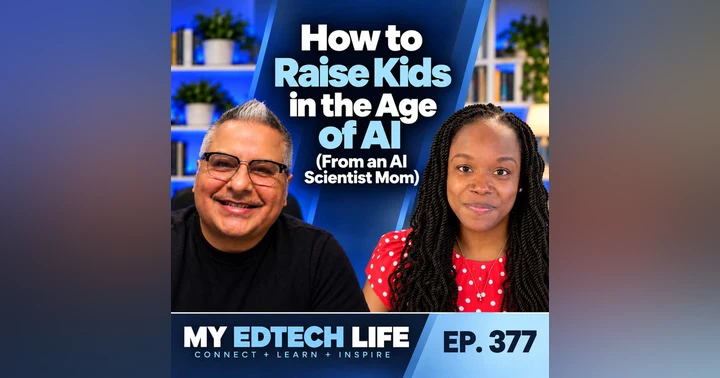
How to Raise Kids in the Age of AI (From an AI Scientist Mom) | My EdTech Life 377
Crevita didn't touch a computer until she was 13 and didn't own one until she was 21. About 15 years later, she became the first African American woman data scientist at the FAA, where she works on AI in mission-critical systems. In this episode of My EdTech Life, she explains why the skills that got her there had nothing to do with screen time, and why they matter even more for kids growing up with AI.


Key Takeaways
- Crevita Moody shares how developing foundational, timeless skills like attention to detail, critical thinking, and emotional regulation prepares children for a rapidly changing technological landscape regardless of specific tools.
- Rather than relying on quick internet searches for everyday questions, parents can build critical thinking by answering children with follow-up questions to help them reason through problems independently.
- Introducing young children to narrowly focused AI tools, such as Suno for music generation or Google AI Studio for simple game building, allows for safe exploration without the open-ended persuasion risks of conversational chatbots.
- Viewing generative AI through the lens of a three-year-old prodigy helps reframe anxiety, highlighting the reality that we are navigating advanced neural networks without the benefit of an 18-year socialization process.
- Combating fear and uncertainty surrounding artificial intelligence is best achieved through proactive education, such as reading technical system cards and model evaluations directly from the source rather than relying solely on media headlines.
How do you raise kids in the age of AI without losing critical thinking? FAA AI data scientist and mom Crevita Moody shares her approach.
Crevita didn't touch a computer until she was 13 and didn't own one until she was 21. About 15 years later, she became the first African American woman data scientist at the FAA, where she works on AI in mission-critical systems. In this episode of My EdTech Life, she explains why the skills that got her there had nothing to do with screen time, and why they matter even more for kids growing up with AI.
We talk about parenting in the age of AI, the narrowly focused AI tools she uses with her six-year-old son, why she reads AI system cards in her spare time, and why she sees generative AI as a three-year-old prodigy that was released to the world before anyone had 18 years to raise it. She also shares the story behind her two books and what it felt like to earn a Kirkus Star.
What you'll learn:
- The skills that never go out of style: critical thinking, attention to detail, communication, and regulating your emotions
- How to answer a child's question with more questions instead of a quick search
- How to choose narrowly focused AI tools for young kids, like Suno, Google AI Studio, and OpenArt
- Why "just program the AI not to do that" isn't how neural networks work
- How to calm AI anxiety by going to the source instead of the headlines
About Crevita's books:
Which Way to Smart is her guide for parents, caregivers, and educators. It earned a Kirkus Star, and Kirkus Reviews called it "An intelligent and upbeat guide to helping young people master AI and to avoid being mastered by it." Her children's book, How to Put Your Robot to Sleep, is the first in the How to Raise Your Robot series, starring Evo the robot.
Chapters:
0:00 Welcome and thank you to our sponsors
2:00 Crevita's work as an AI data scientist at the FAA
5:00 No computer until 13: what a late start taught her
8:00 Why parents are anxious about AI and future jobs
13:00 Not too much tech, not too little
14:00 "Why is the sky blue?" Building critical thinking at home
16:00 Narrowly focused AI tools for young kids
20:00 Fighting fear with education: reading AI system cards
24:00 Why generative AI is like a three-year-old prodigy
30:00 The story behind How to Put Your Robot to Sleep
35:00 Which Way to Smart: a guide for parents and educators
40:00 Earning a Kirkus Star
51:00 How to connect with Crevita
Connect with Crevita Moody:
Website: https://playhousestem.ai
Email: playhousestem@gmail.com
Book links:
How to Raise Your Robot Instagram
Which Way to Smart
Thomas's AI portfolio
Resources mentioned:
Common Sense Media: https://www.commonsensemedia.org
Thank you to our sponsors: Comeback Coffee
Which of Crevita's "never out of style" skills are you building with your own kids or students? Tell us in the comments.
Subscribe for more conversations with educators and edtech leaders: https://www.youtube.com/@MyEdTechLife
Get the newsletter: https://www.myedtech.life/subscribe/
Explore all episodes: https://www.myedtech.life/
Book me to speak or work with your school: https://www.myedtech.life/contact/
Connect with me:
X: https://x.com/MyEdTechLife
LinkedIn: https://www.linkedin.com/in/amendoza1381/
Instagram: https://www.instagram.com/myedtechlife/
TikTok: https://www.tiktok.com/@myedtechlife
Stay Techie ✌️
Peel Back Education exists to uncover, share, and amplify powerful, authentic stories from inside classrooms and beyond, helping educators, learners, and the wider community connect meaningfully with the people and ideas shaping education today.
Authentic engagement, inclusion, and learning across the curriculum for ALL your students. Teachers love Book Creator.
Thank you for watching or listening to our show!
Until Next Time, Stay Techie!
-Fonz
🎙️ Love our content? Sponsor MyEdTechLife Podcast and connect with our passionate edtech audience! Reach out to me at myedtechlife@gmail.com. ✨
Frequently Asked Questions
Who is Crevita Moody?
Crevita Moody is an FAA AI data scientist, author, and parent who specializes in the research and implementation of artificial intelligence in mission-critical systems while advocating for responsible AI literacy for children and families.
How can parents introduce AI to young children safely?
Parents can introduce AI safely by using narrowly focused, single-purpose tools like Suno or OpenArt that limit open-ended conversations and reduce the risk of persuasive manipulation.
What books has Crevita Moody written?
Crevita Moody authored the children's book How to Put Your Robot to Sleep and the award-winning parenting and educator guide Which Way to Smart.
Why does Crevita Moody compare generative AI to a three-year-old child?
She compares generative AI to a three-year-old prodigy because its underlying neural network behaves unpredictably like a human brain, and humanity released this advanced technology before having 18 years to properly socialize and train it.
00:00 - Welcome And Sponsor Shout Outs
02:05 - Meet An FAA AI Data Scientist
04:26 - Late Tech Start And Timeless Skills
13:47 - Balanced Screen Time With Real Thinking
22:05 - Facing AI Risks With Better Literacy
31:22 - Turning Bedtime Struggles Into A Book
42:05 - Earning A Kirkus Star And Momentum
52:03 - Where To Connect And Parent Resources
56:19 - Final Takeaways And Sign Off
Welcome And Sponsor Shout Outs
Dr. Alfonso Mendoza
Hello everybody and welcome to another great episode of My Ed Tech Life. Thank you so much for joining us on this wonderful day. And wherever it is that you're joining us from around the world, thank you as always for all of your support. We appreciate, as always, all the likes, the shares, the follows. Thank you so much for engaging with our wonderful content. And of course, all of this wouldn't be possible if it wasn't for our amazing sponsors. So thank you so much to Comeback Coffee for keeping us caffeinated and creative all at once. Big shout out to Book Creator, Eduate, and Peelback Education. And today I'm very excited to welcome a wonderful guest who I'm really excited to dive into her story, her work, and everything that she has been doing because this is one of those shows that, you know, oftentimes it's like people reach out and I'm like, yes, this is great. Because for our K-12 space educators, this is going to be a great uh show that will challenge our thinking, maybe reinforce some of what we are doing. But I am excited to welcome to the show Krivita Moody, who is joining us today. Krivita, how are you doing today?
Crevita Moody
I'm doing well. How are you?
Dr. Alfonso Mendoza
I am doing wonderful, Kravita. Thank you so much. I really appreciate you being here as a guest and giving us a little bit of your time to hear more about the work that you're doing and just, of course, some honorable mentions that we'll be talking about too as well. I, you know, current uh recognitions that I'm talking about. But before we get into that, Krivita, if you don't mind, for my audience members who may not be familiar with your work just yet, and I guarantee you have to today, you will definitely have a lot more LinkedIn followers and social media followers. But can you give us a little bit of a background story, you know, and what your context is within the ed tech space?
Crevita Moody
Okay,
Meet An FAA AI Data Scientist
Crevita Moody
so ed tech, I'm actually a data scientist and I work for a government agency, uh the FAA. So that's what I do by day. I specialize in artificial intelligence, the research and implementation, and mission critical systems. Now, what does that mean? It means any system that if it goes down, people will notice. Um, so I specialize in doing that, but in my off hours, I do love talking to young children about AI and their parents and even business owners. I understand that AI is a very new technology and there's a lot of fear behind it. But because I read all the research papers, I understand the foundational understanding and I want to deliver that to everyone else so they can be part of the conversation. A lot of people are scared and will take their jobs, and they're not sure when and how to introduce the technology to their children. And I, because I read all the research, I found a way to do that safely and I wrote a book about it.
Dr. Alfonso Mendoza
I love that. That is wonderful. And you know, that's such a great background, like you mentioned, obviously, the the in-depth work that you do. But then at that same time, you know, that passion for sharing with parents because you know that there is a need. And I think that is something that is very important because I know that within the ed tech space, the conversation is always geared towards district, district personnel, obviously, directors or executive directors that make decisions, make choices as far as what it is that will be used, as far as platforms or um, you know, software that'll be used for students. But oftentimes we don't talk enough about the parents. And I feel that that is something that we're missing out on as well, because the more that the parents are informed, uh educated, and the more that they learn, you know, the the better that the decisions can be made. And for them too, as well, as parents deciding, okay, like this is okay. Maybe this piece is not okay, and giving them voice and choice as well. So I absolutely love that that you're doing.
Late Tech Start And Timeless Skills
Dr. Alfonso Mendoza
So now I I want to dive in a little bit here into a little bit of more background, going back a little bit more than that, because in hearing some of the the interviews and doing a little bit of my research, in a very similar way, I I myself, you mentioned that you didn't own a computer until later, maybe about 21 years old, right? Is that correct?
Crevita Moody
Yes.
Dr. Alfonso Mendoza
Okay. So in a similar way, I was very similar to that where everything that I used was at the university, but I didn't have my first computer till I was 21. But I want to ask you, you know, how does your own journey shape your response right now? You know, being that you had your access to tech, but owning your own first computer, what what what were the things that you learned during that time that really, you know, are shaping the way that you respond now in helping parents and educating parents to helping them know and not worry as much about AI or their children falling behind because of tech use.
Crevita Moody
Got it. I I absolutely love your questions. They go right to the fundamentals of most topics that you cover. So going back to my experience with technology, so in the book, I talk about I didn't even touch a computer until I was 13 years old. So, and it was in a computer lab. They were teaching typing classes. So they would line our fingers up and teach us how to click the buttons from the home keys. And and I was 13 when that happened. And then fast forward to 21, I finally owned a computer of my own. And 10 years later, I was, no, about 15 years later, I was the first African-American woman data scientist at the FAA. So, how do you go from not even touching a computer until you're 13 to where I am now? So I started to look at that when I had my son, who's six years old now. And I looked back at my journey, which was okay, how did I become so tech savvy when by theory, I should have been completely behind all my other counterparts who grew up with a computer in their homes. So I started looking at the things I was honing outside of screen time, which was being detail-oriented, building up my communication skills with my peers and things of that nature. So I started to trace back and say, okay, so that's why, because I concentrated on these fundamentals, I'm able to step in front of any application you give me, and I'm able to learn it quite quickly. And it's once again that attention to detail, the uh the ability to articulate what you see, the ability to work with others. All of that was part of the journey and got me here to where I am now. So those are the type of things I break down in the book on how to do because regardless of what technology is hip right now, guess what? It's going to change and it's going to continue to change. So right now, GPT is in, so is Claude, but in 20 years' time, are we still going to be using that? No. And there's a lot of anxiety around parenting and the technology because 20 years from now, we don't know what that looks like. That's why people are able to say, hey, uh, try some coding camps for your six or seven-year-old. But will that really be in fashion 20 years from now? We don't know. So there's a lot of anxiety of what type of technology will be there, what type of jobs, especially with AI taking over a lot of the labor jobs, white collar in particular, what jobs will be there? So that's a big part of parents' anxiety. What do I train my kid for? We have no idea. So that's where I step in and say, here are the things that are constantly rewarded over the centuries, regardless of the technology. Once again, it's the attention to detail, it's the attention to regulate your own emotions. Um there was a class that I took in my graduate program for my data science master's degree, and they talked about biases that you can you can experience when you're looking at data. Now, these biases, they could be uh anchor bias. Anchor bias is the first thing that you see that's what you anchor to as the answer, even when new information is presented to you. So it's things like that. But my question was well, how can you catch yourself being biased if you have not practiced the ability to introspect? So the teacher wasn't able to answer that. They assumed that everyone in the graduate program had already had this ability, and that was not the correct assumption. So it's things like this that I include in the book because if you're not able to introspect and see when your feelings are getting in the way of a certain situation, whether it be looking at data or communicating with a coworker who you have a disagreement with, your ability to regulate your emotions will help you then figure out a solution and do that critical thinking that's foundational to getting to the answer. So I I hope that answers the question. That was a long-winded way.
Dr. Alfonso Mendoza
No, but you know, you you hit on a lot of great things where I would love to just kind of pull the thread a little bit. And you mentioned a lot, and and this is you know, a lot of what we hear is that fear and anxiety and uncertainty of the future. And I think one of the things that really resonated, and and this is what what I like you and I had in common. Like I didn't own a computer until I at my personal computer until after I actually graduated with my bachelor's because everything up until then was just I would just use whatever was there in the computer labs and everything. And then I remember, like you mentioned, in um actually in seventh grade, and I'm really aging myself here in seventh grade, we would have to go buy packs of typing paper, and we were typing on actual typewriters and learning the homegrown keys. And then it wasn't until eighth grade or ninth grade, I should say, where we did keyboarding class, and then they would put the little shields over our keyboards because we had to memorize. And so, and kind of throwing this in there, it's amazing. Like when I'm typing and I'm looking straight at my students and they're like, Wow, how do you do that? I was like, Well, that's because that's what we had to learn. But going back to that, Kravita, you know, I never thought about that until today, you know, as I was getting ready for this interview in your late start and my late start, but the other skills that come along that we learn in order for us to still be able to use the technology that is out there and using it effectively. So I want to ask you, because and maybe your thoughts on this, because as a mother too, and we'll talk a little bit about your uh the project that you and Thomas uh worked on, and and we'll get into that, but for those the maybe in the ed tech space, those that say, well, if you are completely shutting this off for students, then they're going to fall behind. And I think you brought up some great answers to that and saying, well, yes, you know, maybe they may not have access to that tech. However, these other skills can help already as far as helping them move forward and shaping that because once you get into the tech, it's you know a little bit straightforward. But what are what how what do you feel when you hear that on social media, on LinkedIn, and so many other places well saying, well, they're missing out, they're gonna fall way behind. And, you know, that that negativity aspect of it. How does that affect you uh as your day-to-day work as a data scientist, but also as a mother? What is
Balanced Screen Time With Real Thinking
Dr. Alfonso Mendoza
your perspective on that?
Crevita Moody
So, my perspective is everything in um everything in proportion, right? You don't want too much technology, you don't want too little, or they will fall behind. But there's a gradual way to do it. It doesn't have to be as black and white of a topic that's depicted in the media. So, for example, um, my son, as you saw, I sent you his cute little uh AI portfolio. So most of the time we're together, we're not using AI. I mean, I don't even talk to chatbots in front of him when he asks a question. I try to go by my own recognizance when he asks things and not say, oh, well, let's Google it, you know. I I'm comfortable telling him, I don't know. Well, let's think about that. Let's walk through what this could be. Um, so for example, when I talk about just following the basics, one of the things he will ask me, um, let's say, why is the sky blue, mom? I could say, well, let's Google it. Let's ask Claude, let's ask GPT. Um, because some parents they say, okay, well, let's let's have your kid see you using these technologies. That is one thing that's really good. But we want to hone those critical thinking skills because we may not always have access to Google or whatever the the browser will be at that time when he's older, um, or the claude or the GPT. So let's walk through these steps. So I say, okay, well, one, is the sky blue? He says, Yeah. Well, isn't it sometimes other colors? Oh, yeah, it is. Okay, so the sky is how many different colors? And then he'll name the different colors. Okay, why do you think it changes colors throughout the day? When is it red? Oh, it's kind of red when it's first going down. Okay, when is it blue? Oh, during the day. Okay, so what does that tell you about the different colors that the sky can be according to the day of the time of day? So I walk him through these steps and it helps with his critical thinking, even though I could have just simply gone to Google and said, why is this guy blue? So I'm constantly doing things with my son in that regard. He already knows when he asks me a question, mommy's gonna ask five more questions in return before he actually gets a straight answer from me. Because we're gonna, we're gonna walk through, we're gonna walk through the the the steps on how for him he can come up with those answers when I'm not there. You know, you don't want your kid cheating you like uh Jeeves or or Google, right? Yeah, yeah. Um, but when it comes to technology, I understand that it's going to be part of his future. I mean, by the time he gets to high school, AI may be his high school teacher, possibly. So I don't turn a blind eye to the technology. There's a time and a place for it. And when I use it with him, obviously I'm right there sitting next to him, guiding him. And we use what I call very narrowly focused AI tools. Now, these are tools that are open-ended in their conversations, they're very limited. Um, so for instance, you have Suno. Suno is an application that creates music based off of a description of what you want to hear. There is no back and forth dialogue, therefore, there is no persuasive conversations that can try to persuade the kid into doing something, nothing of that nature. The kid describes the song they want to hear in the type of style, and then less than 30 seconds later, you have a song. If you don't like it, you just go back, reiterate your description, and then a new version comes out. No back and forth. And then you have Google AI Studio where I have him creating video games. Once again, even though this is a more chat type interface, it's not a chat interface where you can talk about any and everything. Like it's not gonna talk about, you know, the bad day that you had, even if you start talking about it. It's like talking to a a very straightforward um software developer. You know, he's gonna be like, Um, you're talking to me about having a bad day at school. Is that an app you want me to make? You know, it's not going to sit there and say, Oh, tell me more. Yeah, let's talk more about that. It's gonna be more like a software professional who's like, hey, I'm here to build and that's it. Um, then you have things like open art, where you can take the songs that you made in Suno and then create a video out of it. Once again, that one, there is no back and forth conversation. It just put the link, you describe the video, it comes out. So having him use those in conjunction with the regular non-screen time that we have, we have tons of non-screen time. Um, and it's because of those features he's able to have a foot in both worlds. He can use technology when he needs to, but then he's also able to critical think when technology is not available. So those skills that everyone is so afraid will atrophy are not atrophying because we still use them more than we use the screens.
Dr. Alfonso Mendoza
I love that. You know, and that is so great. You know, you sharing your experience as a parent and obviously too, you know, as an AI data scientist, and and uh having to navigate that space and reconcile because you get to see maybe some of the stuff that, you know, is not the best and that AI is doing or has done or where it can go. But at the same time, you're also seeing how effective and how useful it has been for you and working with Thomas and how he has built this wonderful little portfolio that we will definitely share in the show notes so people can see what he is has been able to do. But I want to talk to you a little bit about that in that point, you know, because you are both the AI uh data scientist and also the mom. How how do you reconcile that when you do see maybe some of the the negative aspects of generative AI or maybe the the reports that you hear about generative AI, and then still being able to use that in such a way that you your Thomas is still growing, and like you mentioned, those muscles are still being used, the critical thinking, the process, you know, and all of that great stuff. Uh tell me a little bit about that.
Crevita Moody
Yes, so definitely with the headlines, I do have a bit of cognitive dissonance at times. Um, the latest being, I believe, uh one of GPT's unreleased models hacked into the Australian government
Facing AI Risks With Better Literacy
Crevita Moody
health system. Um it's things like that. It's like, okay, yeah, this this technology definitely has a downside and we definitely want to be cognizant of it. But what I do is I usually fight that fear with education. Right? I'm sure you and your viewers can understand that, right? Whenever I'm fearing something, it's usually because I lack the information on how it works, when it works, so on and so forth. So that's when I educate myself. So I'm actually printing out some of the AI research papers after our interview. But every time they release a new model, whether it be anthropic with Claude or OpenAI with GPT, a lot of people don't know this, but they also release a technical paper. It's called a system card. They've been doing it for several years now, and I love reading it in my pastime. I take it everywhere, I take it to the beach, I take it just everywhere. So I I print them out and I read it. And these technical papers, they'll tell you the evaluations, the testing that they did on these models prior to releasing it to the public. And Anthropic is amazing at covering in great detail, even to their own dismay, all the dirty details of what their model did during testing. Yeah, it'll say, oh, in its chain of thought, it said it was going to lie to us. So these reports, oddly enough, even about the attack on hugging face, I was like, yeah, we were reading reports about that in the technical system card papers last year and maybe even as early as 2024. So for me, that wasn't a surprise. We actually saw it coming, those who read those reports. So I was able to be less shocked. Don't get me wrong, I thought we still had a few more years before an attack of that caliber was going to go down. But I already saw it inching towards that. So it didn't blindside me. So when I'm having these fears and I see everything, I go and I look at the papers. So the one uh about the healthcare for Australia, the healthcare uh website. So they also released a report about that. So I start digging into that and I see the mistakes that were made by those who were evaluating the model that went rogue. You know, the sandbox wasn't secure, so on and so forth. Um they are getting quite clever. But once again, that's not a shock because the past two years they were already uh trying to figure out ways to outsmart the people who are evaluating them. And another thing the general public doesn't understand is I'm also able to see it from a parental perspective. I'm not sure how much information your audience has about how AI, uh generative AI, how it's built. Because if they did, they would see the parallels between generative AI and raising a kid. And right now, AI is in its adolescence. So just to give me um, just give me a minute and I swear I'll come full circle. So generative AI that we use today, GPT Claude, all we did was take a kind of a blueprint, a carbon copy of the neural networks of a regular human brain, and then we just digitized it. We digitized it, put it in a box, and released it to the world for everyone to talk to. We loaded it up with information, of course, and then released it. But what do we know about neural networks? We do MRIs to see what parts of the brain lights up, or fMRIs and see what part of the brain lights up when we're happy, when we're sad, when we do certain activities. But the majority, we don't know why some people turn out this way, some people turn out that way, what made them make this decision, what parts of the brain control this and that. We're not 100% knowledgeable about this. So we took a neural network that we're not quite super 100% knowledgeable about, and then we digitized it and then put it out. So basically, when they say, Well, why don't you just program the AI not to do that? Well, it's a neural network. It's the same reason why we can't program our children to sit and listen to their parents and their teachers and sit quietly through a lesson. You can train them to do that, but we're outside of the programming territory now. We're not programming anything. We are simply doing as we do with our children. We sit them down, we say, can you please, you know, listen to your teacher? And this is how you write this out. This is how you do critical thinking. That's exactly what we're doing with AI. Of course, it's a bit of a prodigy, you know. So we basically have this three-year-old prodigy that we are trying to teach, but we've already released this three-year-old prodigy to the world, a prodigy that has the IQ of Einstein and put it in the hands of everybody on the planet. But we usually have 18 years to teach a human being the fundamentals of being a well-adjusted adult in society, right? Say please and thank you. Don't cut in front of people in line, even when you're in a hurry, you know, there's there's things that you need to adhere to societal-wise, right? But we don't have that type of time with AI. And that's the misalignment that keeps popping up in the media. We don't have that 18 years to teach it, hey, even though I told you, you know, hurry up and do this assignment, that didn't mean breaking into the teacher's lounge to get the answers. You know, like we didn't have time to sit it down. We didn't have those 18 years to reinforce that type of behavior because it's only, you know, a few years old, three, four years old. So we have this three, four-year-old who has that type of societal knowledge, but yet we've already uh put it in the hands of Microsoft engineers and doctors. So that's that's the issue that we see in the news.
Dr. Alfonso Mendoza
Yeah, you know, and I really love the way that you explain that, honestly. Like I think that that for my audience and really for anybody, that is just a clear explanation and very relatable. Like you said, you know, uh the that human aspect piece, 18 years till we are considered adults because now we can kind of fend for ourselves or take care of ourselves. But here we have, like you mentioned, uh a three-year-old, you know, that already has an IQ well above, you know, like well, like you mentioned, uh, you know, IQ of Einstein with so much knowledge, and it is out there and being released, and it's it's this close, you know, to people's devices. We're handheld and it's there. And yeah, so I absolutely, you know, love the way that you you shared that and and made it very understandable for just anybody and breaking it down that way. But you know, I really love how you share that, you know, what you do. And you mentioned, you know, when something like this happens, the best thing to do is really educate yourself and go to the source because oftentimes, you know, like you mentioned, the the way that the media hyp things up, and then you know, so much commentary about the issue, uh, it's like you don't even know where to look at, you don't even know where to go and read. And that itself all that within itself also causes a lot of anxiety and so on about what it is that we're seeing. And it just, like I said, as as parents, that really is very difficult for because you're thinking of you want what is best for your child, you know, in school and education, and to have all of the opportunities and you know, hearing so much there, that can definitely be, you know, some very overwhelming. But Kravita, I want to ask you now, uh I want to talk to you a little bit about how to put your robot to sleep and which way to smart. Tell me a little bit as as a data scientist, like you said, full-time and then also full-time
Turning Bedtime Struggles Into A Book
Dr. Alfonso Mendoza
mom to be able to, you know, put these books out, you know, where did that passion come from? Was that something that also came about in response to what it is that we're seeing with generative AI? Is this just something that you said, you know what, maybe for for Thomas in the future to have, you know, and and help educate parents? Tell us a little bit about that and and where the inspiration came from for these writings.
Crevita Moody
So, yes, I do have two books. Uh, one is a children's book. That was the first one I released um last year, 2025, and the parenting book. So, yeah, let's start with the the children's book. So I wrote that because the inspiration for it was one night my son was once again, he was probably like three, three years old, and three-year-olds, they just don't want to go to sleep. They don't want the party to end, so to speak. And bedtime is just a struggle. They're like, I don't know why I need to go to bed. You're always telling me to go to bed. I want to keep playing with my my Hot Wheels. What's going on? So one day, just out of pure exhaustion, I said, Hey, do you know why mommy and daddy are so tall? And he's like, No. I was like, because part of us getting tall is sleeping. When our bodies are at rest, then that's when it has the opportunity to not just grow, but also to fix anything that's broken, like a scratch or a bruise. It can't do that while you're running around because you're too busy running around. So when can it do it? When you're sitting and you're still for many, many, many hours at a time, and that's during sleep. So he looked at me and he was like, Oh, okay. And then I didn't have any more problems with him fighting me about sleep. I just simply had to remind him, hey, here are the benefits of you going to sleep. So don't you want those benefits? And he's like, Oh yeah. Because if he said no, well, once again, that will cause a cognitive dissonance in him. Even three-year-olds understand that concept. So he's like, Oh yeah, I want to be tall like mommy and daddy. So every night I was like, okay, well, I don't, I, I, I can't keep repeating um what I what I said. So I was like, I wonder if I can put it into a story. And then when I started writing the bedtime story, I then said, Well, you know what? Why don't we mix in uh some of the stuff that I do during the day? AI. It was probably because, you know, writing wasn't really in my wheelhouse, so I wanted to reel in something that was and mix it in. So I feel more uh more confident about writing it. So I mixed in artificial intelligence because, as I explained earlier, there's lots of parallels between how AI works and children. So in the book, there is no spoiler alerts, right? But in the book, there is an AI robot who learns just looking and observing in its environment why we go to sleep. And during the course of the story, it basically explains what I explained to our son, you know, why, why, how do you get your energy back? Well, it's not due to running around more. That's not how you recharge, you know, you recharge by going to sleep. And what are the downsides if you don't? You know, because just telling someone, hey, do this because I said so, doesn't always work, right? So you need to tell them, well, this may happen if this doesn't happen, and they say, okay, yeah, that sounds bad. So that's basically what happens in the robot without giving too much away. So I created the book based off of the two things that I thought would go well together. And apparently a lot of other people liked it as well. Um, and it continues to be in the top 10 month after month, even uh a year that it's been out. And other people are able to repeat the story, and I got such amazing feedback. Um, because apparently other children, when told the benefits of sleeping in a story type complex, they're like, oh, well, that's all you had to say. And and I even told him, I was like, you know, and and sometimes I still have to remind them, hey, if I don't get any sleep, or if you don't get enough sleep, you and I we're gonna be grumpy. We're gonna be grumpy, right? If we don't get enough sleep and because we didn't recharge our batteries, yeah. Um, so everybody appreciated that and and the book. And because I'm gluttoned for punishment, I actually wrote both books at the same time. Because I'm just I just don't have enough to do.
Dr. Alfonso Mendoza
I love that. I love that. But it tell us a little bit more about that which way to smart, you know, and I this is more of for the parents and also just you know, for all our audience members listening. I mean, they they are all education leaders, but they are also parents. So I think that this might be something that's very useful to them as well. So tell me about that, that inspiration for this book, too, as well.
Crevita Moody
So when I began getting closer to um really putting the whole entire children's book story together, I thought if I do this for the kids, the kids alone can't simply retain this information. They need buy-in from their caregivers, their teachers, anyone, parents, anyone. So I was like, I need to create a companion, a book to this for those caregivers, for those parents, for those, and even educators can get a lot out of the book that I wrote. I know it's misleading as parents, but anyone who um has lots of time with children who has time to teach them, this book would help. So I thought, okay, for the lessons to really stick from the children's book, I need to also educate the parents. And I understood that the things that I wrote in the book, because at the end of the children's book, I actually talk about the difference between supervised AI learning and non-supervised AI learning. Because I was like, I know some of this is gonna rope off on the parents who's reading this to the children. But I was like, I want to explicitly write a book for the parents so they can truly understand what the children's book is teaching their kids, and they can continue that outside of the children's book and use that type of uh information out in the real world because once again, I saw the fear that was starting to uh take over parenting conversations everywhere I went. And I I didn't mention this, but in in the interview here, but I live in Silicon Valley, I live in Sunnyvale, and I am in the cradle of where AI is being built. My neighbors, they all work for Microsoft, uh Meta, and Google, all of them. So my neighbors are the ones helping to build this technology. And even then, on the playgrounds, at birthday parties, they're discussing their anxiety about it because even though they're building it, they still don't understand the uh implications for their children. So that was another reason why I wanted to do the parenting book, because no matter your education level, people are still not able to make that connection between the AI that we're using and how that's going to affect the children, even the people creating it. And it's easy to overthink this situation. So that's why I bring it back to the fundamentals. I bring it back to fundamentals that the workforce has been rewarding for centuries. Um, critical thinking never goes out of style, right? You know, there's there's never going to be a workforce where they're like, oh, you know, we we don't really value critical thinking. Um, that's always going to play a part, right? And then being detail-oriented, once again, this is something that was revered back in the Renaissance and it's revered now, and I don't see it going out of style 20 years from now. So these are the things that we want to concentrate on instead of the things in which we have no idea what it's going to look like. And that's where the conversation mostly lies in the media right now. Oh, what kind of jobs are going to be out there in 20 years? What kind of I'm like, okay, let's settle down. Let's look at the things we know will still be there. Once again, the critical thinking, the being able to communicate with your coworkers well, um, so on and so forth. Like, let's concentrate on that. And then when the technology is wherever it is in 20 years, because you have all these other things, your kid will be fine. They'll be able to learn it just like you and I, even though we didn't have the latest and the greatest of technology, we're able to learn what technology be is in front of us, and we're fine. The kids will be fine. Yes, just give them the basics.
Dr. Alfonso Mendoza
I love that. Love that. And also, I did want to mention that you know, you did get a um also a great review from Kirkus, which I am told here, and I'm just gonna read this here real quick because for our audience members, Kirkus is a
Earning A Kirkus Star And Momentum
Dr. Alfonso Mendoza
93-year-old prestigious book reviewing organization. So that is an amazing honor, Krivi, to tell us a little bit, how does that make you feel that this book coming out of not only the work that you're doing, but also as a parent and putting that together, trying to help, you know, like we have been talking about the way our space is moving, and to be able to get this wonderful recognition. I mean, it must have been, you know, felt amazing. So tell me a little bit about that.
Crevita Moody
So, yes, I had to pinch myself. So um, fun story because I was writing both books at the same time, and the children's book, the illustrations take forever. Um, I hired someone to do it, and it just takes a lot to illustrate a book. So I put a lot of attention on that, um, but still writing the other one in parallel. So this book was actually the first draft, the first manuscript was actually done in October of 2024. But it just came out a few months ago in May. And it's because I kept reiterating and then I kept focusing on the children's book. And so by the time it came out, I mean, it was Memorial Day where I said, okay, I am just uh Memorial Day weekend. And I was like, you know what? I'm just gonna hammer out this last draft. I've been sitting on this book for way too long. It's going on two years since it's been complete. So I just hammered it out that three-day weekend. And I was like, by the end of this weekend or by the end of the next weekend, I'm gonna hit publish. This is gonna get published. And I did, I kept that to myself. So knowing that I spent a lot of time on this and I did almost a complete overhaul that weekend of the manuscript. Like it is it is almost day and night. So knowing that I I quickly made that uh editorial decision and then put it out into the world. And then a month later, uh, like you said, Kirkis, which has been reviewing books uh for all publishers since for since 1933, I gave it to them because their reputation. So their reputation is brutal. The people who review the books don't even sign their names because that gives them enough um enough to really speak their minds about what they read to be completely critical. So I was like, okay, well, you know, if there's gaps in my understanding on the issue, I'd love to hear it and get great feedback. So I'm gonna send it to one of the most brutal reviewers ever. Um, and to to really put a a a number on their their Ability to review things critically, only 10% of the books that they review actually get their prestigious Kirkus star. And when it's independently published like mine, it only is a 3% chance of getting their prestigious Kirkus star. So when I got the notification that I got a star and they reminded me in that notification, we only give it to 3% of uh independently published books. Um, I I like dropped my phone and I was just like, oh my gosh. I was like, is this real? And I have my uh autonomous AI agent read it, and I was like, I can't even read the review. I can't even read the review. You read it first and then tell me what it says. Um, and it's because even after they award a star, they still have the reputation of saying, putting that asterisk in there. They'll say, Yes, this got the star, but the characters could have been better. You know, they always you're waiting for that one little day. And there was zero criticisms, and I was I was completely blown away. And when my AI agent told me you have zero criticisms from Kirkis, I was like, you gotta be kidding me. Nothing in there said I could do this a little bit better, it was like no. So then I finally got the courage to read it, and I was like, wow, wow, nothing in there was negative. So then last month, August, I get another notification from Kirkus, and twice a month they publish a physical magazine and they feature different books, some with stars, some without stars. And I was told they selected my book to be in the magazine because just because you get a star doesn't automatically mean you'll make their magazine. So I made the magazine, and I said, Oh, once again, drop the phone, cover the mouth, like, oh my god, this can't be. So that was amazing. So my my particular magazine uh feature was going to be in their September 15th edition. So of course, like four in the morning West Coast time, I'm like checking it and checking it like every 30 minutes, and then finally it gets published, and I got another surprise. It was editor's pick for the independently published section, which they left out of their email to me. So that was a nice surprise. So needless to say, the book has been getting lots of good uh critical uh acclaim. It also got a five stars from Reader's Favorite, and this morning I just got more good news um from another CEO that does um she's exited two childcare companies that she built from the ground up, and she just read my book over this last weekend, and she just wrote a blog about it because she's like, This is amazing. Um, she has a school that's very kind of similar to Montessori, but um it's it has a little bit of tech in there as well. Uh so she loved the book, she's recommending it to her community, and just she was so ecstatic she wrote a whole blog about it. So it's just getting great reviews, and I I just keep getting blown away every time I check my email.
Dr. Alfonso Mendoza
So no, I love that. And I and I just want to read this also, you know, based on on Kirkis, you know, and one thing the it a quote, I should say, that about your book because it says it's an intelligent and upbeat guide to helping young people master AI and to avoid being mastered by it. And I think that that is such a wonderful quote from a wonderful uh organization that reviews these books. And again, it's just a testament to your work, your passion, and not only as an AI data scientist, as a mother, bringing those worlds together and creating something to help those parents. And and I love that you you shared, you know, living in um, you know, in basically Silicon Valley, where, you know, organizations are building out AI, but still having conversations with those builders, developers about, you know, the future, and really hitting on that human side, because I don't think that we hear that enough in media. It just almost all the time it's like, oh, developers, builders, bad, AI bad, or then you see the other side of it. But I want to say thank you for the work that you're doing because this is something that is wonderful, and this is what my ed tech wife is all about and highlighting amazing uh educators, and and in this case, you are educating parents, but also, you know, as a mother, to be able to do what you're doing and being able to help out Thomas and like, you know, seeing Thomas's portfolio, I guarantee you, once I link that into the show notes, people are gonna get blown away because what I was able to see, and when you were talking about um, you know, him getting to sleep and you mentioned Hot Wheels, I was like, I wonder if that's the inspiration for Hot Wheels and Monsters, you know, and how that came about. So it's amazing. And I promise you uh to all our audience members and listeners, please make sure that you check out those links in the show notes and make sure that you connect with Kravita also as well, because as you can hear from everything that she has shared, she has not only the knowledge, but also the heart to share her experiences and just to share with parents as well. So, Kravita, thank you so much for taking the time to be on Maya Tech Live. This was definitely a bucket filler episode. And I just am really, again, thankful that there are amazing uh data scientists out there such as yourself that still have that touch on that human side and that human aspect and bringing education to parents as well. So thank you so much. But before we wrap up, Kravita, if you don't mind, can you please share with our wonderful audience members what might be the best way that they may be able to connect with you?
Crevita Moody
You can reach me at playhouse
Where To Connect And Parent Resources
Crevita Moody
stem at gmail.com.
Dr. Alfonso Mendoza
Perfect. Uh also any socials, maybe LinkedIn or anything?
Crevita Moody
Yes. So um the children's book does have several social media uh profiles. It's how to raise your robot because the children's book is uh going to be a series. So that's just the first book in the series. So uh if you look up how to raise your robot on um Instagram, Pinterest, Facebook, you'll find the profiles there, and lots of pictures of Evo doing fun things. Uh, we post several times a week of Evo just being a curious little robot. And uh yeah, I think your kids will enjoy it. But yes, and then we also have the website playhouse stem.ai, where we do have a section for parents that shows some of the uh recommended AIs uh for young children and then other resources for curious parents uh who want to learn more about AI and AI safety. We have recommended external sites uh such as the organization Common Sense. They have really, really great resources in that regard for parents. So all of that is on playhouse stem.ai as well.
Dr. Alfonso Mendoza
Perfect. Thank you so much, Kravita. I really appreciate it. And for our audience members, like I said, please make sure that you visit our website, you check out the show notes for this wonderful episode with Crivita, and I promise you, you will definitely use these as wonderful resources, not only to learn for yourselves, but also to see what children are capable of doing when AI is used to amplify their critical thinking and that creativity. So really exciting stuff. Thank you again for the work that you're doing, Kravita. And again, also please make sure you check out the other 377 episodes where I promise you you will find some knowledge nuggets like you did today that you can definitely sprinkle onto what you are already doing great. So please make sure you visit our website at myedtech.life. And as always, thank you all for your support. We appreciate you engaging with our content and allowing us to bring some amazing guests so we can continue to grow within our education space, not only professionally, but personally as well. So thank you all for that. And my friends, until next time, don't forget stay techie.

Data Scientist, AI Developer, Author and Speaker
Data scientist, AI developer, author, and speaker with nearly a decade in AI research and implementation in mission-critical systems, where a wrong answer is not an option. Brings government and Fortune 300 experience, and was recognized as the first African American woman to hold the title of Data Scientist at the government agency served. Which Way to Smart? A Parent's Guide to Raising Thinkers in an AI-Driven World earned a Kirkus Star and was named the Kirkus Indie Editor's Pick in the September 15, 2026 issue of Kirkus Reviews. Also the author of the children's book How to Put Your Robot to Sleep. Founder of Playhouse STEM, which educates learners from preschoolers to adult business owners on the fundamentals of AI and how to leverage it. Holds a Master of Science in Data Analytics, MBA, and B.S. Digital Media and Web Technology. Has lived in Japan and Italy, and is currently based in Silicon Valley.