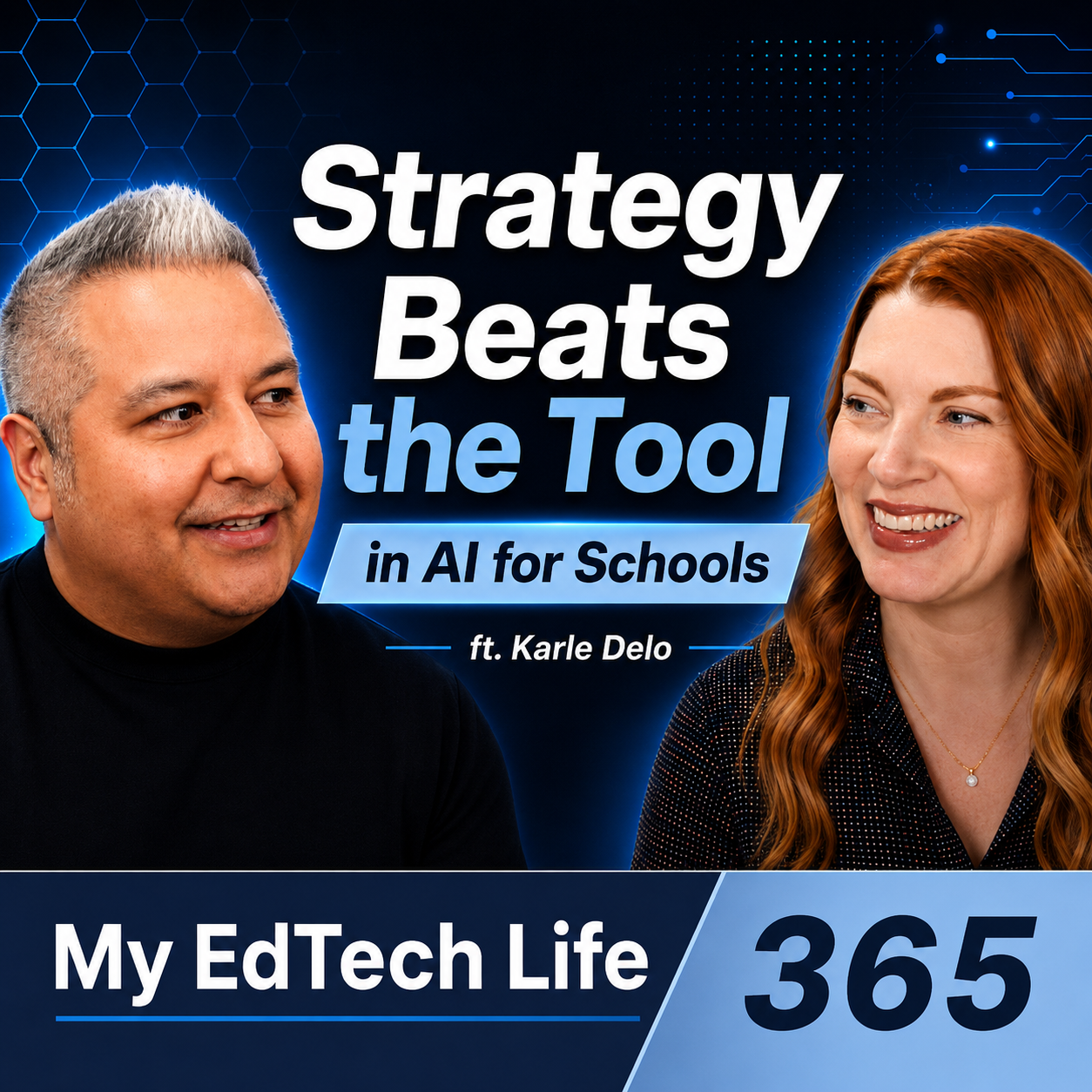
The Three AI Truths Every School Leader Needs to See on a Billboard
Welcome back to the blog, where we unpack the most pressing topics in education, expanding on the conversations we have on the podcast. This week, we're diving deep into the ever-evolving world of Artificial Intelligence in schools, and more specifically, what our school leaders truly need to grasp to navigate this landscape effectively. In our latest episode, Strategy Beats the Tool in AI for Schools ft. Karle Delo | My EdTech Life 365, we had a phenomenal chat with Karle Delo, an AI Strategist at Michigan Virtual. Karle brings a unique, zoomed-out perspective from working with districts across an entire state, identifying what's truly impactful versus what's merely fleeting hype. This blog post distills her essential, high-level takeaways into three core messages that, as Karle suggests, should be emblazoned on billboards for every school leader to see. We'll be focusing on the paramount importance of strategy, the power of community, and the critical need to elevate the student voice in this new AI era.
Billboard Truth #1: Strategy Over Tools
The digital landscape is awash with an overwhelming number of AI tools, each promising to revolutionize learning, streamline administrative tasks, or enhance student engagement. It's easy for school leaders to get caught in the whirlwind of trying out the latest shiny object, chasing the next "game-changer." However, Karle Delo's first billboard truth cuts through this noise with laser focus: Strategy Over Tools. This isn't just a catchy phrase; it's a fundamental shift in how we should approach AI integration. Instead of asking, "Which AI tool should we adopt?", the crucial question should be, "What are our strategic goals, and how can AI, as a broad category of technology, help us achieve them?"
Think about it. If you don't have a clear vision for what you want to accomplish—whether it's improving literacy rates, fostering critical thinking skills, personalizing learning pathways, or increasing teacher efficiency—then any tool, no matter how sophisticated, is likely to be ineffective. Without a strategic framework, AI adoption becomes a haphazard experiment, leading to wasted resources, teacher frustration, and ultimately, minimal impact on student learning. Karle emphasizes that this strategic thinking requires a deep understanding of the educational problems we're trying to solve. AI is a powerful lever, but levers need to be applied to the right fulcrum. This means leaders must articulate their educational priorities first and foremost. What are the perennial challenges in your district? Are you seeing widespread issues with essay writing? Are students struggling with complex problem-solving in math? Is feedback consistently a bottleneck for teachers? Once these core challenges are identified, then, and only then, can the conversation about AI tools begin, not as the solution itself, but as a potential means to a solution.
Furthermore, a strategy-first approach encourages a more sustainable and equitable implementation. When schools adopt tools reactively, often driven by market trends or peer pressure, they risk creating a fragmented and inconsistent experience for students and educators. A well-defined strategy allows for a more thoughtful selection and integration of AI technologies that align with the district's pedagogical philosophy and long-term vision. It also means that professional development becomes targeted and meaningful, focused on how to leverage AI to achieve specific learning outcomes, rather than simply teaching users how to operate a new piece of software. This also helps in addressing the "shadow AI" problem Karle mentions in the episode – where individuals are using AI tools without official sanction or guidance, leading to inconsistencies and potential risks. A clear strategy and accompanying guidelines can bring this informal use into a more controlled and beneficial environment.
The implications for school leaders are significant. They need to shift their focus from procurement and piloting individual tools to developing a comprehensive AI integration plan that is woven into the fabric of the district's overall educational strategy. This involves fostering a culture where experimentation is encouraged, but it's always guided by a strategic purpose. It means investing in professional learning that builds AI literacy and critical thinking skills among staff, enabling them to evaluate and adapt AI tools to their specific needs within the broader strategic context. Ultimately, strategy empowers educators to use AI as a catalyst for innovation, rather than a crutch or a distraction. It’s about intentionality, not impulse. It’s about asking the 'why' before the 'what' and the 'how'.
Billboard Truth #2: The Power of Community in AI Integration
The second crucial message for school leaders, as articulated by Karle, is the undeniable Power of Community in AI Integration. This principle recognizes that technology, especially something as transformative as AI, does not exist in a vacuum. Its successful adoption and ethical use depend heavily on the collective understanding, buy-in, and collaborative spirit of the entire school community. This community encompasses not just teachers and administrators, but also students, parents, and support staff.
When AI is introduced into schools, it often brings with it a mix of excitement, apprehension, and often, confusion. Without a strong sense of community and shared purpose, these emotions can lead to fragmentation, resistance, and missed opportunities. Karle highlights in the podcast that many AI initiatives fail because they are implemented in silos, without engaging the people who will be most affected. This can lead to a "shadow AI" problem, where individuals use AI tools illicitly because they feel unsupported or uninformed by the official channels. A robust community approach, on the other hand, fosters transparency, shared responsibility, and a collective commitment to navigating the complexities of AI together.
What does a strong community around AI look like in practice? It starts with open and honest communication. School leaders need to create forums for dialogue where all stakeholders can voice their concerns, ask questions, and share their experiences with AI. This isn't a one-time town hall; it's an ongoing process of engagement. It involves actively involving teachers in the decision-making process, seeking their input on how AI can best support their teaching practices and student learning. This collaborative approach can lead to more practical and effective implementation strategies, as teachers are on the front lines and have invaluable insights into the daily realities of the classroom. It also combats the idea of AI being an "add-on" imposed from above, fostering a sense of ownership and agency among educators.
Furthermore, the community extends to students. As we'll discuss in the next section, student voice is paramount. But even before that, ensuring students understand the ethical implications of AI, how it's being used in their education, and what their rights and responsibilities are is a community effort. This involves educational initiatives for students about AI literacy, digital citizenship, and academic integrity in the age of AI. Parents also play a vital role. Keeping parents informed about the school's AI strategy, the benefits and potential challenges, and how they can support their children's learning is essential for building trust and alignment. This might involve workshops, informational newsletters, or parent-teacher conferences dedicated to discussing AI's role in education.
Karle's insights point to the fact that successful AI integration isn't just about the technology itself; it's about building a culture where AI is understood, discussed, and used responsibly by everyone. When a school community works together, sharing knowledge, supporting one another, and collectively problem-solving, the potential for AI to enhance learning and teaching is significantly amplified. It transforms AI from a potentially divisive force into a shared opportunity for growth and innovation. This collaborative spirit is what truly makes AI integration sustainable and impactful in the long run. It moves beyond a top-down mandate to a shared journey of discovery and adaptation.
Billboard Truth #3: Elevating the Student Voice in the AI Era
The third, and arguably most crucial, billboard message that school leaders must internalize is the imperative to Elevate the Student Voice in the AI Era. While AI offers powerful tools and new avenues for learning, its ultimate purpose is to serve the student. Therefore, understanding the student experience, their perceptions, and their needs in relation to AI is not an optional add-on; it's a foundational requirement for effective integration. Karle passionately discusses this in the episode, highlighting the often-overlooked perspectives of students.
In the rush to adopt AI, there's a tendency for adult educators and administrators to make decisions based on their own understanding and assumptions about how AI can or should be used. However, students are the primary users of these technologies in the learning environment. Their insights into what works, what feels authentic, and what poses challenges are invaluable. Karle points out a particularly poignant observation: when AI feedback from a teacher feels impersonal or generic, it can be perceived by students as dismissive or even insulting. This is a powerful reminder that AI should augment, not replace, the human connection and personalized guidance that teachers provide. Students crave authentic interaction, and they can often discern when that is lacking, even when AI is involved.
Elevating the student voice means actively seeking out their perspectives through surveys, focus groups, and open dialogue. It means asking them direct questions like, "How does AI impact your learning experience?", "What are your concerns about AI in school?", and "How can AI be used to better support your learning journey?" The answers to these questions can be eye-opening and can directly inform policy and practice. For instance, students might reveal that while they appreciate AI tools for grammar checking, they find AI-generated essay feedback to be overly formulaic and unhelpful for developing their unique writing style. This insight can then guide educators to use AI for specific, targeted purposes, while ensuring that human feedback remains central to developing higher-order thinking and creative expression.
Furthermore, involving students in the development and evaluation of AI initiatives can foster a sense of co-ownership and empower them to become responsible digital citizens. When students are part of the conversation about AI ethics, academic integrity, and the appropriate use of AI tools, they are more likely to engage with these concepts meaningfully and to internalize the principles of responsible AI use. This is not about giving students the reins to dictate technology policy, but about ensuring their lived experiences and perspectives are integral to the decision-making process. Their understanding of the digital world and their comfort with technology often surpasses that of adults, making their input indispensable.
The "AI-slop cycle" that Karle mentions in the podcast is a prime example of what can happen when student voice is ignored. This cycle occurs when students use AI to complete assignments, teachers use AI to grade those assignments, and graders use AI to evaluate the AI-generated work, leading to a compounding lack of genuine learning and critical thought. By elevating the student voice, schools can break this cycle. Students can help identify where AI is being misused and how learning processes can be structured to promote authentic engagement rather than superficial AI-assisted completion. Ultimately, empowering students to be active participants in the AI conversation ensures that technology serves their educational needs and fosters their growth, rather than becoming an obstacle to genuine learning and human connection.
Putting It All Together: Actionable Steps for School Leaders
So, how do these three billboard truths translate into tangible actions for school leaders? It requires a deliberate and integrated approach:
- Develop a Strategic AI Vision: Instead of chasing individual tools, identify your district's core educational goals. Then, explore how AI can strategically support these goals. This involves creating an AI integration framework that aligns with your existing curriculum and pedagogical approaches.
- Foster Community Engagement: Establish ongoing dialogue channels for all stakeholders—teachers, students, parents, and staff—to discuss AI. Provide transparent information about AI initiatives, their purpose, and their limitations. Organize collaborative professional development that empowers teachers to become strategic users of AI, not just operators of tools.
- Prioritize Student Voice: Implement mechanisms to actively solicit and integrate student feedback on AI use in learning. Empower students to be critical consumers and creators in the AI landscape by teaching them about AI literacy and ethics. Use student insights to refine AI implementation strategies and to prevent the "AI-slop cycle."
- Invest in AI Literacy for All: This isn't just for tech specialists. Ensure that educators, students, and even administrative staff understand the fundamental concepts of AI, its capabilities, its limitations, and its ethical implications. This builds a foundation for informed decision-making and responsible use.
- Embrace Iteration and Learning: The AI landscape is constantly evolving. Adopt a mindset of continuous learning and adaptation. Be prepared to iterate on your strategies based on new developments, feedback, and evidence of impact. Don't be afraid to experiment, but always do so with a strategic purpose and a keen ear to your community, especially your students.
- Focus on Augmentation, Not Automation: Remind yourself and your staff that the goal of AI in education should be to augment human capabilities—to free up teachers for more personalized instruction, to provide students with new avenues for exploration, and to enhance critical thinking—rather than to simply automate tasks at the expense of human connection and deep learning.
Conclusion: Navigating the Future of AI in Education
The integration of Artificial Intelligence into education is not a matter of "if," but "how." As we've explored in this post, drawing heavily from the insightful discussion with Karle Delo on My EdTech Life 365, school leaders hold the key to navigating this complex terrain successfully. The three billboard truths—Strategy Over Tools, The Power of Community in AI Integration, and Elevating the Student Voice in the AI Era—offer a clear, actionable compass. By prioritizing strategic intent, fostering a collaborative and informed community, and ensuring that the student experience remains at the forefront, educational institutions can harness the transformative potential of AI while mitigating its risks. The future of learning is being shaped by AI, and by embracing these core principles, school leaders can ensure that this future is one of enhanced learning, equity, and authentic human connection for all students.
Why Step-by-Step EdTech Instructions Kill Student Critical Thinking