Spotify
 Goodpods
 Apple Podcasts
 Amazon Music
 Pandora
 RSS Feed
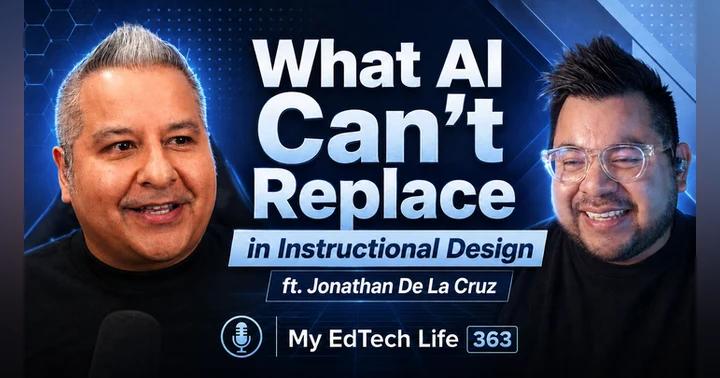
 What AI Can't Replace in Instructional Design ft. Jonathan De La Cruz | My EdTech Life 363
AI can write your design doc. It can build your storyboard. It can draft your script, your rubric, your assessment, your video outline, and half of your e-learning module before lunch. So what's left for the instructional designer? According to Jonathan De La Cruz, everything that actually matters.
AI can write your design doc. It can build your storyboard. It can draft your script, your rubric, your assessment, your video outline, and half of your e-learning module before lunch. So what's left for the instructional designer?
According to Jonathan De La Cruz, everything that actually matters.
Jonathan is an instructional designer at a supply chain company and at a Plano, Texas startup building an AI-assisted learning management system. But before all of that, he was a music educator. He worked at DePauw University and Indiana University. He played mariachi on weekends, jazz combos, cathedral gigs, Costa Rican punk reggae, full symphonies. He didn't know "instructional designer" was a job title. He just knew he loved video editing, building websites, and figuring out how learning actually happens.
In this conversation, Jonathan and I talk about the parts of instructional design AI is genuinely making faster and the parts no model will ever touch. The language you use when you collaborate. The way you receive feedback. The relationships you build before you ever press record on a training. The reason someone will or won't watch what you built.
Jonathan also breaks down the custom AI agent he trained on his reviewers' feedback patterns to cut his iteration cycles from version 5 down to version 2. He shares how he manages a tech stack that includes Articulate, Camtasia, Arcade, Figma Make, Claude Code, Gemini, NotebookLM, and Perplexity, and why he just bought a Claude Code membership last week.
If you're an instructional designer wondering where you still fit, an educator thinking about transitioning into ID, or anyone trying to figure out what the human in the loop actually does, this episode is for you.
🎙️ What We Cover:
✅ Why a music educator's brain is built for instructional design
✅ The "agency" lesson Jonathan's first CEO taught him
✅ How to build trust in AI inside a workplace that doesn't trust it yet
✅ The "but vs. and" language hack that changes team collaboration
✅ Why "feedback" is a neutral word and "criticism" isn't
✅ The custom AI feedback agent that cut his iterations in half
✅ His real working tech stack as an instructional designer in 2026
✅ The human capacities to invest in if you want to stay irreplaceable
✅ Why your training won't land if nobody in the room likes you
Chapters
00:00 Introduction to Instructional Design and AI
12:29 The Journey from Music to Instructional Design
21:13 Navigating Confusion in Instructional Design
22:54 The Importance of Collaboration in Instructional Design
27:33 The Human Element in Instructional Design
30:16 Integrating AI into Instructional Design Workflows
39:14 The Importance of Communication Skills
45:46 Final Thoughts and Advice for Future Designers
🔗 Connect With Jonathan De La Cruz on LinkedIn.
☕ Huge thanks to our sponsor Comeback Coffee for keeping us energized and creative through every episode. Check them out and grab some coffee soda!
🎧 Listen to My EdTech Life on every major platform:
🌐 Website: https://www.myedtech.life
🎙️ Apple Podcasts, Spotify, Amazon Music, iHeart, and wherever you get your podcasts
💛 Support the Show:
If My EdTech Life has given you some practical ideas to build on what you're already doing well, consider becoming a Producer or Super Producer through our Buy Me a Coffee membership. Your support keeps the conversations coming.
👉 https://buymeacoffee.com/myedtechlife/membership
Stay Techie ✌🏼
Thank you for watching or listening to our show!
Until Next Time, Stay Techie!
-Fonz
🎙️ Love our content? Sponsor MyEdTechLife Podcast and connect with our passionate edtech audience! Reach out to me at myedtechlife@gmail.com. ✨
00:00 - Welcome And Sponsor Shoutouts
01:58 - Jonathan’s Path Into Instructional Design
04:08 - Curiosity And Transferable Skills From Music
10:39 - First Instructional Design Role And Agency
20:03 - Collaboration Skills That Make Work Easier
27:42 - Building A Practical AI Powered Workflow
39:25 - Human Skills That Stay Valuable
46:27 - Rapid Fire Questions And Final Takeaways
Welcome And Sponsor Shoutouts
Dr. Alfonso Mendoza
Hello everybody and welcome to another great episode of My Ed Tech Life. Thank you so much for joining us on this wonderful day. And wherever it is that you're joining us from around the world, thank you as always for all of your support. We appreciate all the likes, the shares, the follows. Thank you so much for engaging with our content. We really appreciate all the feedback. And the more feedback you give us, guys, the better we can uh the better, the more we can improve and the better episodes we get to do for you. I would definitely love to give a big shout out to our sponsors. Thank you so much to Comeback Coffee for keeping us highly caffeinated and energized during our episodes. Thank you so much to Book Creator, Peelback Education, and EduAid AI for all of your support. So we can bring you some amazing episodes like the one right now. And I am really excited because I have a wonderful guest that I would love to welcome to the show, Jonathan De la Cruz, who is somebody that I've been following for quite a while on LinkedIn and seeing the type of work that he's doing. So I'm really excited that he's here so he can go ahead and share a little bit about the amazing work that he's doing. And obviously, we'll get into all things at tech, or actually all things tech and AI as well, of course. So, Jonathan, how are you doing today?
Jonathan De La Cruz
Good. Thank you for that introduction, Alfonso. Um, or uh congratulations, Dr. Alfonso, right? Yes, thank you. Of course, yeah. So I'm doing well. I appreciate you having me on. Uh, this is my first ed tech or instructional design podcast invitation. I've done a few music ones uh and some radio ones as well. And so this is completely new for me, but I'm sure we're gonna have a lot of fun here on our conversation.
Jonathan’s Path Into Instructional Design
Dr. Alfonso Mendoza
Absolutely, Jonathan. Well, I'm really excited. So before we dive into the heart of the conversation, can you give my audience members who may not be familiar with your work just yet a little brief introduction and the and also a little uh preview into the world of Jonathan De la Cruz as far as instructional design? Uh that way our audience members can definitely make sure they connect with you as well.
Jonathan De La Cruz
Of course. So I can't get into the world of instructional design until I talk a little bit uh about what happened before. So I have an education degree in music, and I studied music for a very long time, and I was fortunate to teach um at two universities, uh, one of them being DePaul University and the other one was Indiana University as a director of music for a little bit. And uh once I moved to Texas, I taught music all around the DFW and in many different ways, and eventually I caught myself getting interested more into um everything, instructional design without the the title to it, right? So everything technology, learning softwares for music, learning how to video edit, learning how to create a website. I was interested in all those things, and I didn't know there was a job that did a little bit of everything. So um later on I came into instructional design and um now I work at supplying chain as an instructional designer, and I also work um as an instructional designer for a startup here in Plano, Texas. Um, it is uh a startup that does an AI assistant learning management system, and we also have uh other couple of products that we uh we do. Something that just came out recently was called Solo School, and Solo School is a basically a study tool, very similar to Notebook LM, um, but it has a use case um specifically for college students, high school students, um, people who have um kids that uh study um like at-home parents kind of thing. Um, so we also service that. And that's a little bit about those roles in instructional design that I that I focus on.
Dr. Alfonso Mendoza
Hey, well, you know what? I really love that background because you know, coming in from that music field and then now doing the work that you're doing, you know, sometimes, you know, the the the roads that we follow aren't always the roads that we g get into, but you got a little taste of the music side of it and then getting into instructional design. For myself, it was getting a little bit into the marketing and sales aspect, and then getting into teaching, and then, you know, and it's very interesting, you know, those roles. And so I want to ask you, I know I know you started a little bit talking about, you know, the the kind of the technology side of it as far as video editing and everything. But before you you kind of went into instructional design and doing music, was that already something that maybe you already had a small interest in or were already involved, being that you were in music, uh, you know, and and being using that creativity and uh bringing in those uh technology tools into the classroom?
Jonathan De La Cruz
Yeah, so I think before uh 2020, um I don't think a lot of my friends uh in the music field had uh home studios, for example, or microphones, right? And I was one of those uh people that in college I I got my first interface and I have a microphone and and I had my computer and all my friends would look at me like, oh, what do you what is that? What is that for? Even though we were all studying music. So I was always looking a little bit forward um from um starting to post on social media, on Instagram, all my gigs, to getting into video editing, uh starting a YouTube channel of for music so that I could practice video editing um was one of my goals, and that I ended up doing that. And I was always just interested in the tech side, um, for fun, you know. Um I enjoyed watching people do vlogs, I enjoyed watching people do podcasts, and um ultimately I just said, you know, I can do that. I I I enjoy that, I can do that, and um so I think part of it has been just a curiosity um of any more than anything. Um it doesn't feel like work to learn something new to me um as far as technology or to to have to read or something new or or dive into articles or anything of that nature. So um I just think it just came uh for lack of a better word, more naturally than anything. Um and I've always just been like that it in anything. Um so even on the music side, I was one of the people that really loved all the genres. So you'd catch me playing mariachi on the weekend and playing a jazz concert or playing at a a cathedral or or doing a small jazz combo gig or singing or um learning or playing with a Costa Rican funk reggae group or playing with a tops 40s group or playing with a symphony. I got to do all that, and part of it was because I just had the curiosity of all the genres. Um so I was very uh well-versed and and rounded and thought, and um, I don't really find it much in much more different than instructional design. Instructional design is you do have to learn how to video edit, but you also need to learn how to um how to talk to subject matter experts and how to get the right answers from them based on the questions that you ask, right? Um, so that's more of a social thing rather than doing something like video editing, which is like more more singular, right? Um and um from doing some curriculum-based things to virtual or in-person training, you know, you know, you know, know how to do that. So it's been it feels the same. It doesn't feel much different. The only thing is that I don't uh blow on an instrument all the time. Um, but other than that, everything feels the same. Um, I don't really find much difference in it. It's still social, um, and it's still collaborative, which that's kind of where music is, right? Yeah. So instructional design, it does not feel foreign at all. It feels like I've been doing this for a long time.
First Instructional Design Role And Agency
Dr. Alfonso Mendoza
I love that. You know, and and that's something you you said a couple of things there that I definitely want to unpack. And number one, obviously coming at this with that heart of curiosity, and that's something that is so, so important that I think for a lot of educators that are out there that are wondering, you know, in classrooms, and and you had the classroom experience, like you said, you taught music, you know, and it it it curiosity is so important to students to want to engage in the learning and they're curious. And once you spark that curiosity, then you can go in deeper to those lessons, you get that attention uh from the students, and and as well as long as you present it also in a way that is very conducive to them and and their learning styles and so on. And I think it it's social. You that's the other thing that you mentioned is how social learning can be for yourself. Those examples of learning so many genres, that means you had to talk to so many people that were playing those genres and learning from them, learning, you know, uh some theory from them. Why go from this chord to this chord in this genre, and then in this other genre it's a little bit different, and so on. So I think that's something that is very important, and I think that in what you are saying, I can hear how easy that transition came for you to go from the teaching to teaching music, playing on the weekends and so on, and now going into instructional design with that heart of curiosity as far as how do I do some video editing? Okay, I once I get this down, how to communicate and collaborate. And like you said, it it's really it's like you're jamming the whole time because you got to communicate, like you, you know, if you're playing bass, you gotta communicate with your drummer, you're gonna be in the pocket, and you gotta make sure that you're in the pocket, so your singers, you know, got everything he's gotta do, and he's got his cues and so on and so forth. So I really love just that that conversation of music within this transition for you, and now working as an instructional designer and like you mentioned, talking to a lot of subject matter experts and making sure that you get their vision and their messaging and be able to create, you know, something from that, creating a deliverable that somebody's gonna go ahead and use, whether it's for uh more continual learning or uh reviewing and things of that sort. So let me ask you your your first dive into instructional design, because I we do have a lot of educators that listen to the podcast, and a lot of them are always sometimes curious about instructional design, or maybe they're not familiar that this might be something that they might be able to transition to also based on the skills that they have. But what was your first um you know impression and your that feeling that you got when you first entered the instructional design feel?
Jonathan De La Cruz
So I I think it was confusion. Um I I think that would be the word. I think part of it is because um I didn't really realize how many different types of instructional designers that there were. Some of them focus on content, some of them focus uh more on training, um, some of them focus a little bit more on like the manager side of instructional design. And um so whenever I joined the startup and I was their first instructional design intern, that's how he started. Uh I met with the CEO and he said, Okay, what do you do? And I was like, Oh, I can uh I need to interview you so that I can figure out gaps so that I can figure out what kind of training that I can do, whether it's job aid or video or um some kind of training, something like that, right? And he's like, Okay. So uh I mean anybody else can do that here. You know, what do you do specifically? And I didn't really have a clear answer to that question. I didn't, even though I had taken the courses, um, I'm one of the educators that ended up uh taking certificate courses um at the University of North Texas, took four classes, and even though they gave me some good structure for uh models such as the ADI model, the SAM model, the 3D holistic model, or whatever I was taught, I mean, once I got into the actual field, it felt a little bit more little um like I was in open water all of a sudden and I didn't have a paddle, you know. And um so within that, I I the first thing that the startup taught me is agency, and I didn't know what agency was at the beginning. Um, and let me know if I derail a little bit because I'll I'm a little bit on your question, but um going back to the confusion piece, that's where I picked up the idea of agency as far as like now I have to figure out what I'm gonna do here, I'm gonna figure out how to plan that and then how to execute that, right? So um what I did was I basically went around the startup and figured out where the gap was. At the beginning, a lot of the issue was that there was mistrust in the use of AI and or um like it was just unfamiliar to everybody. It's like if it was um the 90s and the internet just got introduced to the masses, right? That's what it at least to me, that's what it felt like. And a lot of the people that haven't really used the internet for more than looking something up or looking up a restaurant or to planning a trip, um some some generally some people just use it for that, which there's nothing wrong with that. But how do you suddenly introduce this completely new technology um which the startup focuses on, which is an AI assisted learning management system, uh, to the people that are that have a budget to purchase that system, right? How do you talk to them about it without um the idea of fear, without the idea of this this is a learning process that it's going to be unfamiliar and confusing, and this is how I'm here to guide you. Uh, within that's the vantage point that I always go by, right? And um, so then from there, I we started using all the tools. I did articulate storyline courses um that were very specific. I did articulate rise courses, I started using Camtasia to do walkthroughs, and some of it worked and some of it didn't, right? It it's not until we got some data and some feedback until we realized that some of it wasn't really working, and that's when we started transferring to other tools. So we currently use at the startup a tool called arcade.software, and it basically does the same thing that Camtasia does in the sense of giving you a walkthrough, but this time with arcade, you can click and it takes you to the next section, and it it gives you the idea that you're doing something, and it takes you from picture to picture, and it guides you with a small uh snippet, a sentence or two that guides you to what you're actually doing and what the next step is. And that helped a lot of our users uh being able to utilize the system without being confused or derailed a little bit more, right? Because I think the trick is is to figure out how to get people from the beginning point to the end point of the learning journey and having learned whatever whatever idea that they did have to learn or whatever system or or part of the product that they did. Um, so going back to there was a lot of confusion on my part, and then figuring out what I had to do at the startup uh due to the agency, which is basically another word for proactive, just be proactive and figure things out and say, Hey, these three projects didn't work, this is why they didn't work, and you move on to the fourth project and you just do it better. And I think that um that's kind of how I started. I started by by being confused and fading a little bit more than I wanted to, um, in that regard. And I was so fortunate that my friend Josh, the Josh Barry, the CEO of that company, was just more interested in the idea of agency that I had and the the kind of like the stubbornness of I'm gonna figure this out. Um that I just ended up staying with the company after my internship. And um, and I would they I was surrounded by UX UI designers, developers, and then there was just me. You know, everybody else was they didn't really understand what I did. And um, so that was how I started. I started in my journey, and and going back to your initial question, that's kind of how I felt.
Collaboration Skills That Make Work Easier
Dr. Alfonso Mendoza
That's I mean, that is like such a great story, I think, for everybody to listen to. And I I I don't understand, uh, and I hope you understand, I should say, how great your response was, especially now with of course, with AI and a lot of the AI tools now that are kind of facilitating things a little bit better. And yeah, I think you and I both follow uh Dr. Luke Hobson, also who's an instructional designer, and he's continually talking and pushing the boundaries as far as what he's able to do with AI in instructional design. And so hearing a little bit about your journey, uh, I think to me, the what really sticks out the most, and I know that this is a tech podcast, so we are talking a little bit of tech, but it it's just really that human side and that that you're describing, the the fear, the confusion, but then all of a sudden just that resilience, that grit to be able to figure things out. And so those are the skills too that now I think are becoming or have become very valuable now within a job setting. Because, like you mentioned, I love that you said that at the that point in time came where you know your your boss said, you know what, like that agency, I I love what you're doing, you're being very proactive, you're figuring things out, you're going above and beyond to make sure that you know the message is conveyed, that the learning that needs to be done is being done and how it's presented. And I think that's something that you know sometimes we don't talk about enough. And as far as now with so much tech and how easy the tech is making things, and obviously because we see the headlines too. I mean, we see the headlines where they're like, oh, this company, so-and-so, just laid off 10% of their workers because they want to make sure they automate everything. And then later on, a couple months later, they're like, oh, guess what? They hired everybody back because they realized that that automation wasn't gonna work all well on its own. And then, of course, the deal of losing customers too, because now you don't have that human in the loop per se. So I think it's something that's very important that you hit on a lot of things there. And and that's something that I really appreciate you sharing because I know that there are many people that are very interested. There are a lot of people that are very interested in the instructional design field, or even current instructional designers that are just beginning that just need to hear that hey, we're okay. Jonathan, he's going, he's he's the same feelings he's sharing right now is exactly what I'm going through. And so we're okay. We're okay. But now, Jonathan, let me ask you. I mean, now working for a company that has uh that AI product, and of course, you say you're working alongside uh UX and UI uh people as well, you know, yeah, the user experience, user interface people, and then you being kind of I see you being as that communicator of here's what is created, here's what we need them to learn, and you're the one that puts all of that together. Talk to us about how important that collaboration piece is, even though we are highly tech driven and there's such a big push for AI and technology, but tell me your experience and on that human aspect of it. How important is that to you on the day-to-day to make sure that your work gets done?
Jonathan De La Cruz
Yeah, so I think a big piece of collaboration is uh the use of language that you use in order to communicate. Um, I was just having a conversation uh with my mom the uh actually today. Uh the things that I've learned throughout this these jobs, widgets in ed tech and and uh supply chain where um where the certain phrases can really change the way that people uh receive your communication. I'll give you an example. Um so one of the things that I learned recently was that if you were to give me an idea and we were working together and we were part of a a collaboration to get some training out, um it would work better if I uh changed my language to always serve uh whatever the output we want it wants to be. So for example, if I if you give me an idea and and I might not think that that idea might work, right? But I say, well, your idea sounds really good, but right, suddenly I've taken your idea and I've put it aside and I'm gonna replace it with my idea now, right? So changing that but to and has kept your idea in the loop, and now we can put them side by side, and we can automatically collaborate, and now you feel heard within the conversation still, right? So if if I say um Dr. Alfonso or Dr. Mendoza, um, hey, I really like your idea, and I'd like to make suggestions, and we've done something similar to. This right, so that that creates a great environment for communication to where I just didn't close your idea or close you off from the communication because now my idea is entirely present, right? So just one of those things um has really changed the way that I I function with people. Um, another thing is something like recognizing someone as idea as being completely genuine or new or well thought out. I think people really like the idea of also receiving some kind of praise where it doesn't have to be like, yes, it was this was the greatest thing I've ever heard, but it's it can be something specific, right? Where it's not like hey, good job. It's I really like the way that you organize yourself. I really enjoyed the framework, and I can't wait to look for the execution of this specific project in this regard, right? And that in another sense makes people feel heard um as well. And I think overall, when people collaborate, they want to feel that their ideas are still in the room alongside them, and it's not just me. So I think that piece has really helped me um be able to collaborate with people. Also, the idea of feedback. So, as instructional designers, feedback to me is a neutral word, it is not uh criticism, which is criticism, I think, feels neutral to me, but it leans on the side of negative to other people. So I use the word feedback, um and um I just look at it as uh opportunity to grow a little further, right? So whether my project um uh changes, pivots, which is a great word, um, it pivots or or whether the project is rejected entirely and we're going with a completely new one. Um understanding that that feedback is a neutral word because the whole goal is to get the learner to the end. And it's not for me to say, well, I worked really hard on this project, we should put this out. Um that that's not the goal. The goal is the learner. So um just removing my myself out of that and just receiving that feedback as neutral to get to the end point of what the entire goal is, um, is most important. And I think in that sense, having those thoughts in mind and collaborating with other people, um, I think has really helped me um have really good outputs. I think it really does. Um now, something I do want to say is as instructional designers, you're gonna work with everybody. So I work with developers and sometimes I don't understand what they say. Like I don't understand what you're saying as far as system designs or integrations, or I might work with UXGI designers and they work on tools I know nothing about. Um, or in the supply chain I work with in operations, for example, and sometimes I don't even know what some of their jargon is, right? So this is where the part of collaboration is is saying, hey, I don't understand, can I have more clarity? Or hey, um, you know, I'm hearing you say all this information, can I have some visibility on those documents? Um, that kind of of language has really helped uh collaboration, and I think I do really well in that respect uh in that regard, even though I might not know anything about what specific departments do. Um just the language creates that bridge um so that we could collaborate a little bit better initially and throughout. I love that.
Building A Practical AI Powered Workflow
Dr. Alfonso Mendoza
You know, and that to me is music to my ears, you know, and obviously Jonathan, who I've been doing this podcast for a very long time, and you know, we we focus uh we always you know talk about keeping the human in the loop and so on, but I'm really enjoying this conversation because I think for a lot of people they hear like instructional designer and you're thinking, well, this is a person who's you basically kind of maybe working solo and you know they're not getting it, they're they're creating a deliverable, but the amount of communication that you are sharing with me that you are having with so many other people, but not only that, but the communication that is given to you and the way that you're translating that to help you improve your, you know, your method, your your design for that curriculum, for that learning to help meet the goals and and it's just encompasses the whole team. I think that's something that is wonderful to hear in this world where like we've seen so many AI tools flood our space, and it just seems like every day there's something new for something out there, and of course, what with Claude and Claude Code and and everything, you know, the the things that can be done now, also for instructional design, have become a little bit uh you know, easier and things that we can only think of now, you know, can actually come to fruition. However, all of that is for not for nothing if you don't have, like you mentioned, those goals in place, that communication. What is the end result for this learning? Because you can have all the greatest tools in the world, but if you're not getting to where you need to be, then you know what what what good is all those tools? So I'm really enjoying the fact that you are sharing the importance of that human uh communication, that human connectivity, the human in the loop, and how important it is even now. And you're working in a startup that has an AI product, and I'm sure that there are many other AI tools that you are being that you are using. So I want to ask you, you know, how how do you manage that? How are you as an instructional designer? Uh I know like I shared, you can have all the tools, but you want to always make sure you get to the goal. But how do you yourself, you know, uh if for any new instructional designer or uh people person thinking about going into instructional design, how do you manage your tech stack? What is it that you look for? Um, you know, walk us through that to see how it is that you get to your your end goal or your deliverable.
Jonathan De La Cruz
Yeah, so um the first thing that I do want to say is that AI has really helped take away some of the monotonous work. So um I do believe it's uh completely in the human in the loop. Um, but the human in the loop in the portions that need for in the portions in which I need to be available, right? So before I started integrating AI into a lot of my workflows, I was doing design documents and just typing everything out, thinking everything through, um, which is fine, right? But now you can go ahead and and prompt your thought process, your framework, whether you're reading the the 3D holistic model or the ADI model or the SAM model or you're doing rapid prototyping. Um, you can also reference some projects that you've done, and then you can put the new objectives, and then boom, you're I wouldn't say you're done, but now you gotta read it. And you just spent, I don't know, 20 minutes on something that would have taken you a couple of hours and a couple of iterations, right? And that doesn't mean you don't have more iterations, but now you have a skeleton template that you can work off of that you can always adjust based on the output and the new objectives or the changes um and pivots, right? So that's the first thing. So it's kind of taken me away from some of the design documents. Um, I would say 50 to 70 percent, depending on the complexity of the project. Um, but I still have to think through um the human pieces. For example, if I'm doing a training, yes, it's gonna create the entire script andor outline and what the objectives are, everything like that. But I have to think about what the person is doing while the the facilitator is doing their part, right? And I also have to think about whether some of the things in which the output has been given is is the best thing that they need to know in order to uh make the change in their workplace. So um those are the things in which I've used AI for at the beginning. Now, now that um as far as the models that I've used, um, there's so many new models, but I've gone through Gemini, for example. Um, I've used Gemini for some coding. I'm taking currently a machine learning Python class, and we use that. Um and I've messed around uh with cloud code for some time and perplexity AI, part of partly because the startup is it's developers, UXUI designers, and me. And the AI the tools that we use as instructional designers, which is articulate and some others, you let's scratch articulate. I'm not gonna say, but all the instructional design tools that we use, they're slower than the design tools that coders use, and UX UI designers too. For example, Figma has Figma make. Um, so now they can have a complete output, make adjustments by just using uh a couple of sentences. Um, and of course, they have to a UX designer that that really knows their stuff would have their framework, their kind of designs that they want, but then their output is massive, like you know. So sometimes I'll show up in our meetings, and we had an output from from the developers and the UX GI designers, and I'm over here still spending time on some of the e-learning tools that we use, but they haven't really caught up. Some of them are very, very manual, right? So, one of the conversations is from the CEO of the startup, which is like, hey, let's try to get you to go from 30% usage of AI to about 50. Um, so what does that look like? So experiment with perplexity at AI, spend another month on cloud code and see what kind of things you can learn, and then pick your tool of choice and stay with it for a period of time so that you can learn the ins and outs, right? Uh, for a while it was chat GTP. Um, we went away from chat GTP. Uh, we started using uh I think WindServe, as far as the developers were using an AI feature from WindSurf, and now we switched to codecs in the startup, right? Um, so and partly it was because uh everybody was just experimenting. Um, so um that's basically how uh we're going about it. I think I think my suggestion to people is that they should stay with a specific AI tool um and learn the features. So going back to Gemini, I've used uh Google AI Studio, uh which anti-gravity, um Google Labs. Um I've spent a lot of time time on Python on Google Labs using Gemini feature there. Um a lot of on Google uh notebook LM2. I spent so much time uh working on that, and I even uh have some outputs based on those project projects that I built there. But um, so that and then after that I've just decided hey, I'm gonna spend uh a couple of months on cloud code. So I just got a membership actually last week for cloud code. It's been coming up everywhere. Now they have cloud design, um, and um just just kind of experimenting and figuring that out. Um, but I think part of of the way that I use AI has been to save time. I'll give you an example. Um, so some so sometimes I don't really understand certain feedback from specific people because I think they have a certain way of speaking, a certain language that they want to use in some of the documentation or some of the outputs. And sometimes the way that we think is completely different. Some people speak more romantically, some people are more technical, uh, some people are are a little bit more nonchalant in their language, even when writing, right? So something that I thought about is like every single time that I give an iteration on a project, um I get I I get the project back with a bunch of changes of like the language all the time, or the structure, or maybe the way I phrased the sentence, or maybe where I added a m-dash or or a semicolon or something like that. And I've been doing that back and forth for a very long time, and I say, you know what? I'm gonna get approved documentation on some of the projects that I've done, and I'm gonna train it on the language structure, on the type of feedback that I get, and on the way that they think, a little bit based on what the knowledge that I know. So before I go to this person to submit these documents or projects, I run it through my agent, I get the feedback, I make those changes, and then I submit it, and now we have less back and forth, right? And that has kind of worked. So I just save time. I just save time from me having to do version five of a video, version five of a rise course. Um, now I'm on version two, and people are like good to go, right? So um remind me of the question that you were asking. I went a little off, but that's kind of how I've been utilizing AI for me on daily tasks and workflows, and part of it is just problem solving. What are issues am I having all the time, right? Um, so um, if anything, using AI has helped create all these frameworks and systems so that if somebody says, hey, I need a video in three days, or I need a video in one week, and I need it to be five minutes. I already started with the template and the framework on how I'm gonna approach that project. Because if I didn't have those saved frameworks that I utilized AI to build, it would it was gonna take me it would take me two to three weeks to give the same output, right? So every single time that I build, I keep myself organized enough with all the frameworks, and if I have to do create a new one for a completely different project, um, that's when I utilize AI to do some of that work. Um, and that's kind of how I'm using it currently in my workflows. It's just very systematic and it's gotten better. And I spend a lot less time, like I said, on the monotonous things of like, hey, can you redo 50% of this project? And it's like, what's wrong with it? Oh, it's the language kind of like we don't really use that language. Um, some people use clients, some people use partners, right? For when sending a product, um, for example, or some people use uh the uh the word feedback at work, and some other people use criticize, right? So making all those adjustments um kind of really aided a lot of the time. Um, and that's kind of how I've been approaching everything.
Human Skills That Stay Valuable
Dr. Alfonso Mendoza
And uh, you know, everything that you shared there, very systematic. I mean, and I mean, coming from your experience and just kind of diving in, first of all, diving into instructional design, and then you know, diving into the tech stack and the tools, you know, which tools work best, and obviously what you want, and like you mentioned, I love what you said, you know, it's for efficiency's sake. You want to make sure you're efficient, you're a lot faster. And so the way that you described you know, being able to grab that feedback that is given to you, but using that exact same verbiage and being able to implement that in your output. So when you go and share, now it's like you mentioned, now I'm like 50, 60% there, as opposed to waiting and doing three, four, five iterations. Now a iteration number two, I'm already done, or maybe 80% done on my video. And it's all about being able to get that content out, that that deliverable, that creativity. So it it just I love the way that you describe that so effectively and the way that you are using it efficiently and effectively to be able to solve those problems that and those uh barriers that uh you are going through based on that language and the feedback that you were getting. So I think that's something that is fantastic and so good to hear also that albeit you know, all the tools that we have, still you still need one person that can manage those tools, use those tools, and really use them to shape the output and shape the work like you're doing to work right along with your colleagues too. I mean, it it there's no way that you can automate so much before you lose that that human touch and approach to be able to have something deliverable. Because at the end of the day, your your partner or your clients, they're human and they still need that human interaction. So I really love that. So, Jonathan, this has been an awesome conversation. And and as we kind of wrap up, I want to ask you, uh, we always have our last three questions, so that'll be our little rapid fire round. But for you right now, I want to ask you for if you were mentoring or or if you best advice that you can share with an instructional designer right now, what would it be that you would tell them to invest in? And I'm not talking about a tech stack, I'm not talking about tech tools or anything, but I want to ask about the human capacities. What are some of the human capacities that they should invest in uh that would help them be irreplaceable five, ten, or even fifteen years from now? What do you still see in the world of instructional design that is still going to be important aside from the tack?
Jonathan De La Cruz
You know, I had a conversation um with an uh a friend recently, or I guess a coworker, um co-worker slash friend, and something that she told me is that even if you use all the fancy tools and even though you spend three months working on some training that you're gonna do, it doesn't fulfill the learning if nobody likes you. Right? So I could spend all that time working and I can use all these fancy tools, and if I haven't taken the time to communicate and collaborate with people, um and um show them that I uh appreciate their contributions, that I acknowledge that they're there, then when they show up to my trainings because we all work together, it my training might not be effective at all. And so the investment that I would say to somebody is figure out how to create an environment and a set of skills that are communication-based that will facilitate your life for the and career for the rest of the time, right? Because that's the thing that you take away with you. The tools are gonna change forever. Um, so go ahead and find some books that from your favorite author on communication, and or practice something like podcasting, for example, um, so that you can get better at communicating some of those ideas. Or if you have a husband or wife or a partner that you want to make a presentation to about purchasing a new item, do that presentation and practice, practice that communication. Um, practice the the empathy part as well. Um, read as many books as possible on that because um, yeah, you can go ahead and use AI to figure out what skills you need to be better, but the practicing part is not gonna do for you. The practicing on communicating with someone such as yourself or with three coworkers or with someone that doesn't like me on a team or or with someone who's frustrated that three other projects haven't gone out, and I'm on their fourth project, and they're on a they're they think that this project might not be worth it because everything else hasn't worked. How am I gonna communicate with that person that I'm available to support? Right? So um going back to the idea, yeah, we can prepare all we want and we can use the best tools from next year. But if uh you don't know how to communicate and you just go in silo, put yourself in a silo in your workplace and you don't communicate with anybody when you realize that training or you present that curriculum, people might not watch what you built. People might not finish what you built, people might not take in any of the information, even if it's good or well thought out, because they might not see you as somebody who's allowed them into the entire environment of the workplace. Um, and I think that's the biggest skill. I mean, the tools are gonna be better, they're gonna be faster, and they're gonna work a little bit smarter than than most of us in the world. Um, but that's the peace that we will always have with us. So that's what I would suggest.
Dr. Alfonso Mendoza
I love that. I think that is some sound, sound advice, especially again, as we are constantly being bombarded with just the tech and the tech and what the tech can do. At the end of the day, like you mentioned, you know, there's so many other variables that go into a business and the relationship aspect is something that is so important because just like you described, if if you don't have that relationship with, you know, a certain department or a colleague and so on and so forth, the work that you do together, you know, that that it it may not hit uh the you know home as it should because you don't communicate. And I think that's something that is very important and it still keeps you know you yourself, that human in the loop, because at the end of the day, it's just you know all about communication, collaboration, and all that great stuff. Jonathan, thank you so much. I really appreciate you taking the time to speak with me and for all our audience members also to let us into your world and hear your experience and to amplify your voice. So for all our audience members that are out there about thinking about instructional design, maybe you're thinking about transitioning into instructional design, or maybe you just started instructional design, or you're even a vet of instructional design. You know, I know that what you share today is definitely something beneficial to all of them. Jonathan, before we wrap up and we we hit our our three questions that we always end the show with, can you tell our audience members who might be interested in maybe connecting with you or following you or you know, anything that you share? I know I follow you on LinkedIn. Would that be the best place for for our audience members to follow you on on LinkedIn? Or are there any other socials that where they can follow you?
Jonathan De La Cruz
Yeah, correct. So LinkedIn is basically where I put a lot of my time now. Um, partly is because I do find people so interesting there because they show all their projects, you know. You have animators, you have developers, you have people that do robotics, you have people that do mentoring and education, you have people that do marketing. So um it's just like a creative space. I think all those things are creative. Um, so you can find me on LinkedIn, uh, it's Jonathan DeLacruz, and um, I'll be more than happy to accept accept um your connection there. Um and thank you so much.
Rapid Fire Questions And Final Takeaways
Dr. Alfonso Mendoza
Excellent. We'll make sure that we link that in the show notes. All right, Jonathan, before we wrap up, we always love to end the show with these last three questions. So hopefully you are ready to go. So here we go. As we know, every superhero has a pain point or weakness, and we know that for Superman, Kryptonite was what weakened him. So I want to ask you in the world of Jonathan De la Cruz, in the world of instructional design, or maybe just technology altogether, what would you say is your current edu or excuse me, what would you say is your current uh, I guess we'll say tech kryptonite?
Jonathan De La Cruz
You know, I've had a hard time keeping up with every model that comes up every week, or testing things out. I might have not tested out the last two iterations of a model that came out, whether it's on Cloud Code or Chat GTP, um, or copilot, for example. A lot of workplaces you copilot. Um I have a hard time keeping up. So sometimes people will say, Hey, did you try uh nano banana two? And it's like, well, I haven't even tried nano banana one. Like, how do I keep up? You know, I'm looking at Higgs Fuel AI or something like that, and I'm focusing on that, and uh something comes up. So I think that just keeping up with um iterations of models and at the same time some of the documentation. Um I can tell you um about articles that I read last year when I was reading article across article of of biases in AI or things like that, but I don't know if that information's true because of how fast it's been moving. So I would say that's one of my main weaknesses.
Dr. Alfonso Mendoza
Yeah, no, I and I think that goes for everybody. I mean, obviously, it just seems like in these last two weeks there have been so many drops and they continue to drop, and then new platforms and and you're absolutely right, just to be able to keep up is is it like I have just I guess not necessarily burnt out, but I just go for quick finds and I'll just search TikTok and like I'll find somebody just to share like that bit of what it is, what it does, and then I'll be like, okay, do I want to try it? Do I not want to try it? Or at least I'll save the video and come back to it. But now my repository of you know notes is like long. I was like, when will I have time? And and it's just a matter of making that time, but you know, you're right, that that is definitely a pain pointer weakness. All right, Jonathan, here we go. Since you are in the DFW area, I want to ask you if you could have a billboard with anything on it and just plastered huge over there in the DFW area where everybody can see, what would your billboard have and why?
Jonathan De La Cruz
Um, that's a really good question. Um what would it have? I think it would be some kind of inspirational message um with the idea of an understanding that whoever is viewing it belongs somewhere. I think. I think I think um it's a very humanistic I approach everything with a lot of empathy. Um and I do know that driving for an hour to work, sometimes for everyone in the DFW, I mean it's so common for people to not live where they work here, um, it kind of gets a little draining, you know. Um and I think it's just a reminder that you belong, I think would be probably the biggest thing.
Dr. Alfonso Mendoza
There you go. Good, good message. And yeah, you're absolutely right. The DFW area, it is huge, but I love it. It's a great place. So if you haven't been to DFW, guys, make sure you take a little trip to DFW because there's a lot of stuff to do there. Alright, Jonathan, last question for you, my friend, is if you could trade places with anyone, anyone, for a single day, who would that be and why?
Jonathan De La Cruz
I think um Yeah, I think I think uh it went from like a tech show to like uh kind of like a human uh approach uh kind of centric idea. I think it would be my dad. Um I think uh he did really well in raising my brother and sister and I. And um there was a lot of things that he went through that I just didn't understand at that time. So I think just having a uh a couple of days just being uh seeing things through my dad's eyes and um figuring out what he did to to raise people that were loving, you know. Um so I would I would just go with with that to figure out what he did and how he was thinking uh to raise us, you know. So yeah. Love it.
Dr. Alfonso Mendoza
Love it. Hey, that is a great answer. I think that's probably the first time I ever have somebody say that, you know, they would trade places with their parent. And it's such a great answer, especially wanting to know that experience and and sometimes those hardships that have helped and that they've overcome, but that also affected us in such a positive way. And like for yourself, you know, like you mentioned, you know, raising three loving siblings and everything, that's something that's fantastic. So that's a great answer, Jonathan. Well, my friend, Jonathan, it has been an amazing conversation with you. Uh, thank you so much for being a supporter of the content also that I put. I know that that's kind of how we got connected on LinkedIn. And, you know, thank you so much for engaging with the content. And so when I had the opportunity, I think I was in Puerto Rico when I messaged you and said, Hey, do you want to be a guest on the show? And uh, so that was fantastic. So I'm glad that we were able to make it happen because I really, really enjoyed our conversation. You definitely had so many gems that you dropped that I can't wait for the world to hear. So, for all my audience members, please make sure that you click that link that is in the bio and make sure that you follow my friend Jonathan Della Cruz there on LinkedIn. You won't regret it. He puts out some great content as well. So again, make sure you connect with him. And also don't forget to visit our website, my tech.life, where you can check out this amazing episode and the other 364 episodes. All right, where I promise you you will find some gems and knowledge nuggets that you can sprinkle onto what you are already doing great. And also, thank you so much to all our sponsors, Comeback Coffee. As always, thank you so much for keeping us caffeinated. Uh, Book Creator, Eduade, Peelback Education. We really appreciate you. And also, ladies and gents, if you click on the link in the bio, we also have some My EdTech Life memberships where you can become producers and super producers. And this is just a great way to help continue to support our show. So we thank you for all of that support as well. We appreciate it because we want to continue to bring you some amazing conversations like the one we had today with Jonathan, and we want to help continue to grow our education space. So thank you as always from the bottom of my heart. And until next time, my friends, don't forget, stay techy.

Instructional Designer
Jonathan De La Cruz is an Instructional Designer and Learning Experience Advisor who specializes in the intersection of Artificial Intelligence and adult learning theory. He currently serves as an Instructional Designer for a supply chain company and works with Fuel the Future Platforms, an innovative EdTech software company. At Fuel the Future Platforms, he collaborates on the development of AI-assisted Learning Management Systems (LMS) and curriculum design to streamline onboarding for educational and workforce partners.
Jonathan’s background is rooted in both high-level music performance and academic instruction. He previously served as a Faculty Lecturer of Music at DePauw University in Greencastle, Indiana, where he taught the History of Jazz and Music Appreciation. His academic journey also includes graduating from Indiana University (IU), where he earned his Master of Music in Jazz Studies and founded Mariachi Perla del Medio Oeste through the Latin American Music Center. Shortly after, he moved to the Dallas-Fort Worth area, where he spent time working for the Dallas Symphony Education Center as well as school districts throughout the region. It was Jonathan's inherent love for creating, teaching, and design that eventually led him to discover the field of Instructional Design
Jonathan is currently working toward a Master of Science in Learning Technologies with a concentration in Artificial Intelligence in Education and Learning Analytics from the University of North Texas. He is a bilingual professional, fluent in English and Spanish, an… Read More