Beyond the Algorithm: The Irreplaceable Human Touch in Instructional Design
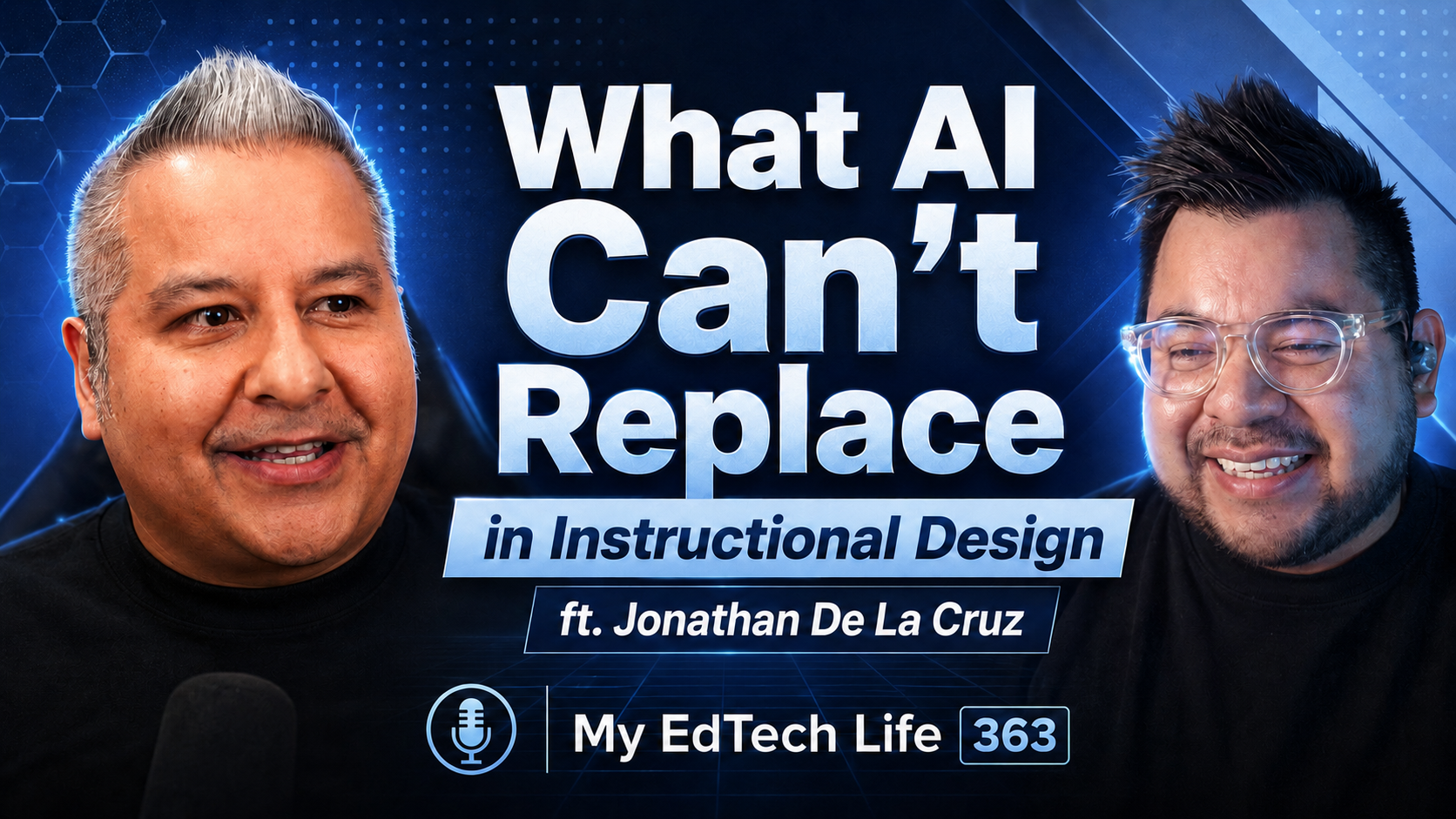
Welcome back to the blog, and to a special post expanding on our latest podcast episode! In this week's show, What AI Can't Replace in Instructional Design ft. Jonathan De La Cruz, we had a truly insightful conversation with Jonathan De La Cruz about the evolving landscape of instructional design (ID) in the age of artificial intelligence. We explored how AI is revolutionizing certain aspects of our work, making processes faster and more efficient. However, as Jonathan so eloquently articulated, there are fundamental human elements that AI simply cannot replicate. This blog post dives deeper into those crucial human touches, the unseen architects of effective learning experiences, and why, despite the technological advancements, our innate human capabilities remain paramount.
The Unseen Architect: Building Trust and Relationships Before the First Line of Code
Before we even think about algorithms, design documents, or storyboards, the foundation of any successful learning initiative is built on trust and relationships. This might sound like a soft skill, something easily overlooked in the drive for efficiency, but it is precisely where AI falls short. Jonathan, with his background as a music educator and his current role navigating AI-assisted learning systems, understands this deeply. He shared during our conversation that the reason someone will or won't engage with the training you've built often hinges on whether they trust you, and by extension, the learning content you've curated or created.
Think about it: if you're tasked with learning something new, whether it's a new software, a company policy, or a complex procedural skill, your receptiveness is heavily influenced by your perception of the source. Is it coming from a place of genuine desire to help you succeed, or does it feel like a sterile, impersonal mandate? AI can generate content, it can even personalize it based on data, but it cannot replicate the warmth of a trusted colleague recommending a resource, the encouraging nod from a mentor, or the shared understanding that comes from knowing someone has your best interests at heart.
Building this trust isn't something that happens overnight or within the confines of a single training module. It's cultivated through consistent, empathetic interactions. It's about showing up, being reliable, and demonstrating a genuine commitment to the learner's growth. This involves understanding their context, their challenges, and their aspirations. It's the instructional designer who takes the time to ask clarifying questions, to actively listen to concerns, and to adapt the learning experience not just based on data, but on human intuition and empathy. These are the seeds of trust, and they are sown long before the first line of code is written or the first video is recorded.
Jonathan's experience, transitioning from a career in music where performance and audience connection are paramount, provides a unique perspective. In music, the performer-audience relationship is dynamic and deeply human. The energy exchange, the shared emotion, the interpretation of the music—these are all elements that cannot be replicated by a machine. This understanding of human connection translates directly into instructional design. An AI can produce a technically perfect piece of content, but it cannot imbue it with the human element that makes it resonate, that makes a learner feel seen and valued, and ultimately, more motivated to learn.
Beyond Automation: The Nuances of Collaboration and Communication in ID
The show notes for our episode highlight a crucial point: "The language you use when you collaborate. The way you receive feedback. The relationships you build before you ever press record on a training." This encapsulates the essence of how AI is a powerful tool, but not a replacement for the human art of collaboration. AI can draft scripts, outline modules, and even generate assessments. However, it cannot navigate the delicate dance of stakeholder meetings, it cannot interpret the unspoken cues during a brainstorming session, and it certainly cannot foster a sense of psychological safety that encourages open and honest collaboration.
Jonathan shared a brilliant "language hack" in our conversation: the power of "but versus and." This seemingly small linguistic shift can dramatically alter team dynamics. Instead of saying, "This is a good idea, *but* it won't work because of X, Y, and Z," we can reframe it as, "This is a good idea, *and* here are some considerations to make it even stronger." This shift from a dismissive "but" to an inclusive "and" fosters a more collaborative environment. It acknowledges the validity of an idea while constructively guiding its development. This is a nuanced communication strategy, rooted in empathy and a desire to build consensus, something an AI, no matter how advanced, cannot inherently understand or implement.
Effective collaboration in instructional design involves more than just sharing documents or attending meetings. It's about active listening, understanding different perspectives, and finding common ground. It's about building rapport with subject matter experts (SMEs), project managers, and other stakeholders. When you have a strong, trusting relationship with your SMEs, for instance, they are more likely to be open with their knowledge, to provide candid feedback, and to feel invested in the success of the learning project. AI cannot facilitate these rich, human-to-human connections. It can't offer a cup of coffee to an SME who's struggling to articulate a complex concept, nor can it share a laugh that breaks the ice during a tense project discussion.
The ability to adapt communication styles based on the individual and the situation is another invaluable human skill. An AI might have a default tone, but it cannot intuitively sense when a learner needs encouragement, when a stakeholder requires a more detailed explanation, or when a sensitive topic needs to be approached with particular delicacy. This adaptability, this fine-tuning of our message based on human interaction, is a hallmark of effective instructional design and a testament to the irreplaceable nature of human communication.
The Art of Feedback: Navigating Criticism and Conversation with Empathy
Feedback is a cornerstone of the iterative design process. Whether it's from learners, stakeholders, or peers, constructive feedback is essential for refining and improving learning experiences. However, the way feedback is delivered and received is profoundly human. Jonathan brought up the distinction between "feedback" and "criticism," a subtle but significant difference. Feedback, in its purest form, is neutral information aimed at improvement. Criticism, on the other hand, can carry emotional weight and can be perceived as personal attack.
An AI can analyze data and identify areas for improvement, generating reports on learner engagement or assessment scores. It can even suggest modifications based on predefined rules. But it cannot deliver feedback with empathy. It cannot understand the emotional impact of a critique on a designer who has poured hours of their time and creativity into a project. It cannot offer words of reassurance, acknowledge the effort invested, or frame suggestions in a way that fosters growth rather than defensiveness.
Imagine an AI telling a designer, "Your module is poorly designed and fails to meet learning objectives." This is a blunt, potentially demoralizing assessment. Now, contrast that with a human feedback provider who says, "I appreciate the effort you've put into this module. I've noticed that learners are struggling with Section 3. Perhaps we could explore alternative ways to present that information, or add a quick knowledge check to reinforce the key concepts. What are your thoughts on that?" The latter approach, infused with empathy and a collaborative spirit, invites discussion and problem-solving, leading to a much more productive outcome.
Jonathan's innovative approach of training a custom AI agent on his reviewers' feedback patterns to cut iteration cycles is a fascinating example of leveraging AI as a tool to enhance the human feedback process. This AI doesn't replace the human element of delivering or receiving feedback; rather, it helps to streamline the analysis of patterns within that feedback. This allows the human instructional designer to focus on the higher-level, more nuanced aspects of interpretation and application. It frees up mental bandwidth to concentrate on the emotional intelligence required to build relationships and foster understanding around that feedback.
The ability to parse not just the words but the intent behind them, to understand the underlying needs and concerns of the person giving feedback, is a sophisticated human skill. It involves active listening, emotional intelligence, and the ability to engage in genuine dialogue. This is where the human touch in instructional design truly shines, turning potentially difficult conversations into opportunities for collaborative growth and improvement.
AI as a Co-Pilot, Not the Pilot: Leveraging Tools While Preserving the Human Touch
The conversation around AI in instructional design often sparks anxiety about job displacement. However, as Jonathan eloquently argues, the reality is more nuanced. AI is not here to replace instructional designers; it's here to augment their capabilities, to serve as a co-pilot rather than the sole pilot. The tools Jonathan mentioned using—Articulate, Camtasia, Arcade, Figma Make, Claude Code, Gemini, NotebookLM, and Perplexity—are all powerful aids. They can automate tedious tasks, generate initial drafts, and provide valuable insights.
But the strategic decisions, the creative problem-solving, the understanding of learner motivation, and the ethical considerations—these remain firmly within the human domain. An AI can write a script, but it cannot decide the emotional arc of a narrative that will resonate with a specific audience. It can generate an assessment, but it cannot determine the pedagogical purpose behind each question or how that assessment will ultimately impact learner confidence and performance. These are the strategic, human-driven decisions that differentiate good instructional design from merely functional content creation.
The true value of AI in ID lies in its ability to free up instructional designers to focus on what they do best: designing engaging, effective, and human-centered learning experiences. By automating repetitive tasks, AI allows designers to dedicate more time to understanding learner needs, collaborating with stakeholders, refining the user experience, and infusing their designs with creativity and empathy. This shift allows the instructional designer to move from being a content producer to a learning strategist and experience architect.
Jonathan’s own journey, starting from a place of genuine passion for video editing and understanding how learning happens, underscores this point. He didn't start by aiming to become an "instructional designer" as defined by a job title; he pursued his interests and discovered how those interests could be applied to create meaningful learning. This innate curiosity and drive to understand the "why" behind learning are precisely the qualities that AI cannot replicate. AI can process information and execute instructions, but it cannot possess genuine passion or the drive for authentic understanding.
The Irreplaceable Skills: Why Human Connection Will Always Be Key to Learning
As we look to the future of instructional design, it's clear that the skills that will remain irreplaceable are those that are fundamentally human. These include empathy, creativity, critical thinking, emotional intelligence, and the ability to build and nurture relationships. These are the skills that allow us to connect with learners on a deeper level, to understand their motivations, and to design experiences that not only impart knowledge but also foster growth and inspire lasting change.
The reason training won't land if nobody in the room likes you, as Jonathan so aptly put it, is because learning is inherently social and emotional. We learn best when we feel safe, supported, and connected to others. An AI cannot create that sense of belonging or engender that feeling of trust. It can provide information, but it cannot foster the human connection that makes learning truly stick.
The instructional designer of the future will be a master of both technology and human interaction. They will wield AI tools with skill and efficiency, but they will always remember that the ultimate goal is to empower and uplift human learners. They will be adept at understanding the nuances of human psychology, at crafting compelling narratives, and at building collaborative environments where ideas can flourish. They will be the architects of learning experiences that are not only effective but also deeply human, meaningful, and transformative.
Conclusion: Embracing the Future of ID with Human Ingenuity at the Helm
Our conversation with Jonathan De La Cruz on My EdTech Life 363 was a powerful reminder that as technology advances, our human capacities become even more valuable. While AI can undoubtedly streamline many aspects of instructional design, the core of what makes learning effective—the trust, the empathy, the collaboration, and the genuine human connection—remains firmly in our hands. This blog post has delved into these irreplaceable human elements, exploring how they form the bedrock of successful learning experiences and how AI, while a powerful co-pilot, cannot replicate the nuanced art of human interaction.
As we move forward, let's embrace AI as a tool to amplify our human strengths, not replace them. The future of instructional design is not about humans versus machines; it's about humans and machines working together, with human ingenuity and connection firmly at the helm, guiding the creation of learning experiences that are not just informative, but truly transformative. Thank you for joining me on this exploration, and I hope this deep dive has provided you with further insights into the enduring power of the human touch in our field.

Dr. Alfonso Mendoza Jr., EdD. Educator, host of My EdTech Life (360+ episodes), and a cautious advocate for pedagogy-first EdTech. Doctoral research on AI in education. Google Innovator (VIA20), Adobe Education Innovator, EdTech Digest Top 100 Influencer. 8,500+ educators trained. Servant leader at heart. Blessings.
Stay Techie ✌🏼
Why Digital Natives Need Emotional Intelligence, Not Just Chromebooks


 Goodpods
  Amazon Music
  Pandora
